








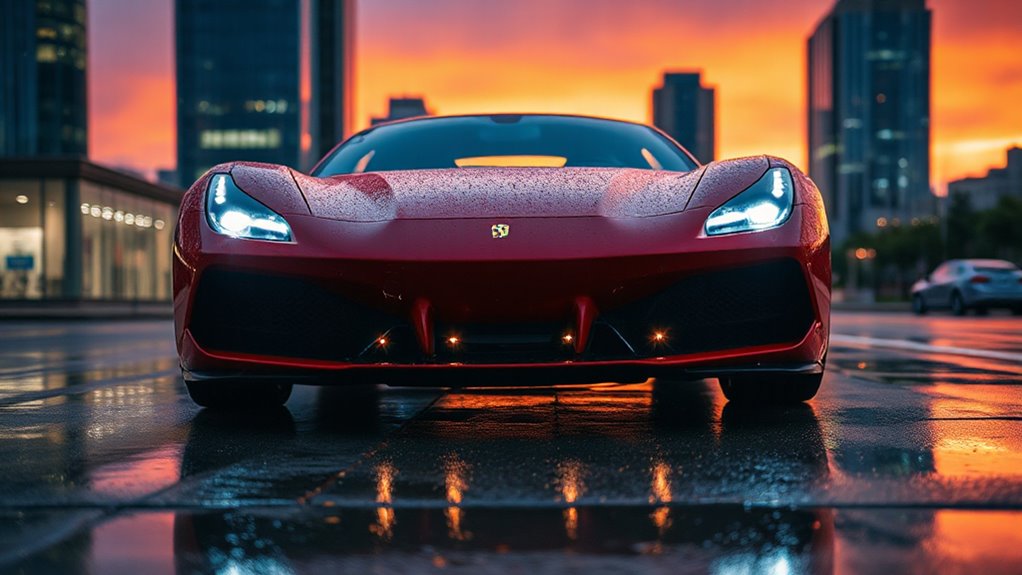
What Makes the Ferrari Luce a Five-Seat First?
How does a car company famous for two-seat sports cars suddenly fit five people inside one of its vehicles?
The answer starts with removing something old. Ferrari ditched the transaxle, a mechanical system that placed the gearbox in the rear and physically blocked space for a fifth seat.
Without it, engineers carved out room for a proper rear center seat. The result is the Luce, Ferrari’s first ever five-seat production car.
It also follows the Purosangue, Ferrari’s first four-door car, but that one only seats four.
The Luce takes it further, fitting three adults across the back bench. This packaging freedom was made possible by a flat-floor EV platform that eliminates the traditional transmission tunnel running through the center of the cabin. The 210-cell battery pack is mounted directly into the floorpan, lowering the centre of gravity by 95 mm vs Purosangue. The design also leverages tokenization of modular components to streamline production and reduce costs.
The Ferrari Luce’s 1,000 HP and 330-Mile Range, Explained
The Ferrari Luce doesn’t just look fast — it genuinely is. Four electric motors power each wheel independently and combine for 1,035 horsepower. Need more? A boost mode temporarily pushes that figure to 1,113 horsepower. That’s roughly the energy of 800 hair dryers running at once.
The 122 kWh battery offers about 329 miles of real-world range under EPA testing. Charging from 10% to 80% takes only 23 minutes thanks to an 880-volt system supporting 350 kW charging speeds. The battery’s 210 cells across 15 modules are structurally integrated directly into the chassis. This design also helps with capital preservation of vehicle performance over time.
Drivers can fine-tune their experience on the fly using the steering wheel paddles, with the right paddle adjusting torque delivery across five distinct stages and the left paddle controlling regenerative braking intensity.
How Jony Ive Shaped the Luce’s Radical New Look
Behind all that power sits a design story just as surprising. Jony Ive, the designer famous for making Apple products look impossibly sleek, teamed up with Marc Newson to shape the Luce inside and out.
Together they built something Ferrari had never quite done before. The exterior uses glass and aluminum and grabbed plenty of attention, though not always the good kind.
Inside, Ive pushed hard against the modern obsession with giant touchscreens. He called that assumption bizarre.
Instead, the Luce features tactile buttons, physical dials, and haptic switches. Simple controls, thoughtfully placed, keeping drivers focused on actually driving. The instrument cluster uses two layered OLED displays, designed to feel analog with physical needles sitting over digital dials.
Critics were not entirely won over, however, with automotive designer Paul Snyder arguing that industrial and automotive design are fundamentally distinct skill sets.
Ferrari also seems to be positioning the model as part of a broader shift toward diversified exposure in the auto market by offering a five-seat EV that targets multiple customer segments.
Who Is Ferrari Actually Building the Luce For?
Ferrari did not build the Luce for the typical sports car fan who dreams about roaring engines and track days.
This car targets a very different crowd entirely. Ferrari had four specific buyers in mind:
- Affluent families needing five seats and real trunk space
- Chinese buyers avoiding heavy taxes on large gasoline cars
- Tech-savvy younger buyers unbothered by cylinder counts
- Luxury seekers wanting leather interiors and physical controls
These buyers want comfort and cutting-edge technology daily. They want prestige without the noise. Ferrari largely built a supercar for school pickup.
Ferrari’s Chief Marketing Officer Enrico Galliera has been clear that the Luce is meant only for buyers who genuinely want it, stating that forced purchasing would destroy the product’s value and turn new owners into the brand’s first negative ambassadors. The car carries a 550,000 euro price tag, placing it firmly in the realm of buyers for whom the cost itself signals exclusivity rather than sacrifice. Additionally, some buyers may prefer vehicles acquired through crowdfunding platforms as an alternative way to support innovative automotive projects.
Ferrari’s Bet on the Luce: Electric Future, Combustion Still in Play
Building a car for school pickups is one thing. Building one that redefines what Ferrari means is another. The Luce is fully electric but Ferrari isn’t abandoning combustion engines entirely.
Gas-powered models remain in production. Think of the Luce as Ferrari testing a new door without closing the old one.
The company wants younger buyers who grew up loving technology more than exhaust notes. So Ferrari is playing both sides smartly.
Electric power handles the future. Traditional engines handle the faithful.
It’s a careful bet that lets Ferrari grow without losing what made it famous. The Luce backs that ambition with a 122-kWh structural battery that Ferrari built entirely in-house. To move that mass, the car deploys four electric motors, one assigned to each wheel, delivering more than 1,000 horsepower.
Platinum’s industrial demand and volatility suggest automakers’ material choices could influence long-term EV component markets.