










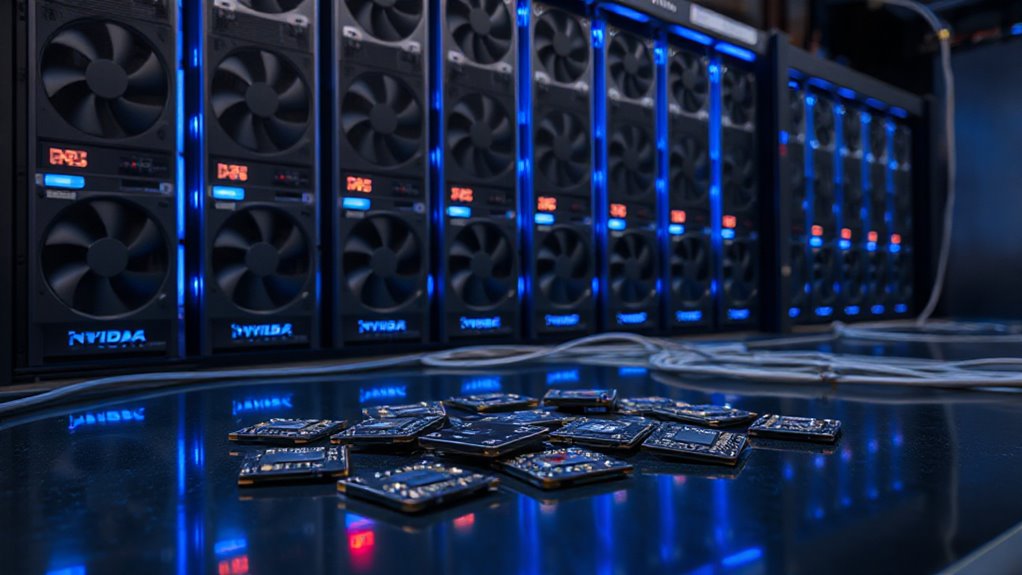
Why would China tell one of its biggest tech companies to stop buying the world’s best computer chips? That’s exactly what happened to ByteDance, the company behind TikTok, when Chinese regulators banned them from using Nvidia semiconductors in new data centers starting September 2025.
This ban isn’t just about ByteDance. Major tech giants like Alibaba and Tencent got hit with the same rules. Think of it like China telling its tech companies they can only eat homemade food instead of ordering from the fanciest restaurant in town. The government wants these firms to use domestically-made AI chips in any new data center projects that receive state funding.
China is forcing its tech giants to ditch foreign chips for homegrown alternatives in state-funded projects.
For ByteDance, this creates a real headache. The company was Nvidia’s biggest Chinese customer in 2025, buying more chips than anyone else in the country. These powerful chips help ByteDance run its platform for over a billion users worldwide. Nvidia’s chips are like race car engines compared to regular car engines when it comes to artificial intelligence tasks.
The timing makes things even trickier. This ban follows an August 2025 instruction telling Chinese firms to stop ordering new Nvidia AI chips altogether. It’s part of China’s bigger plan to become self-reliant on computer chips, reducing dependence on American technology during ongoing tech tensions between the two countries. Nvidia acknowledged that the regulatory landscape limits its ability to offer competitive data center GPUs in China.
Here’s where it gets creative: ByteDance and other Chinese companies found a workaround. They’re training their AI models in Southeast Asian countries like Singapore and Malaysia, where they can still access Nvidia chips by leasing computer power. It’s like studying abroad to use better equipment that isn’t available at home.
Meanwhile, the United States has its own restrictions, limiting which Nvidia chips can be sold to China. Washington allows only scaled-down versions, creating a complex dance of regulations on both sides. Nvidia introduced a China-specific chip, RTX6000D, but demand remains weak. The coordinated regulatory approaches between the US and China during this tech conflict create market instability as investors struggle to predict policy outcomes.
China’s domestic AI chips haven’t caught up to Nvidia’s performance yet, leaving companies like ByteDance stuck between regulatory demands and technological needs. This chip chess game affects how quickly Chinese companies can advance their artificial intelligence capabilities.