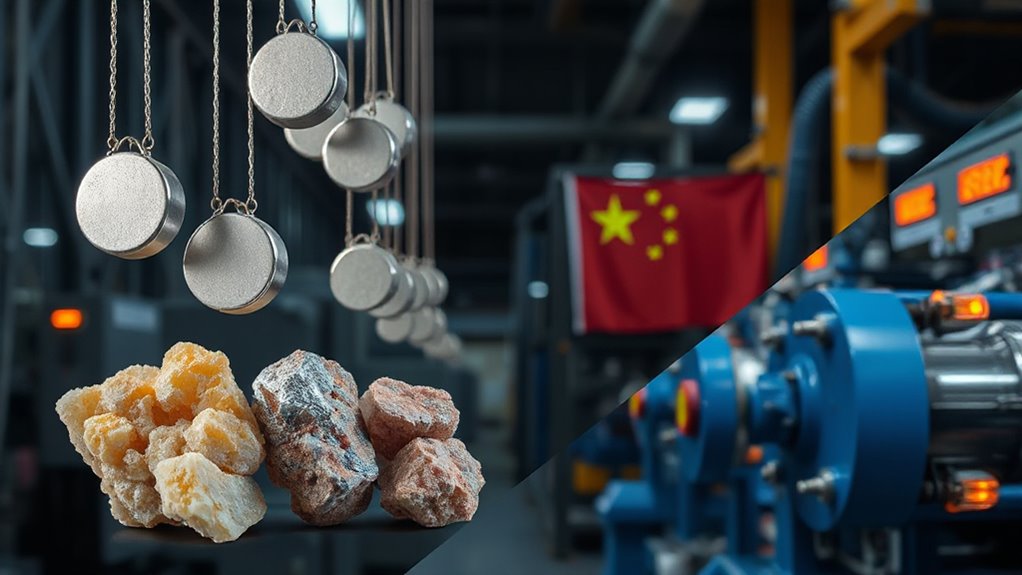
How did the United States lose its grip on rare earth magnets, and can one Oklahoma company bring it back? China now controls over 90 percent of the global sintered neodymium magnet market, a dominance that grew after America stepped away in the early 2000s. USA Rare Earth, listed on Nasdaq as USAR and led by CEO Barbara Humpton, aims to challenge that monopoly with a bold mine-to-magnet strategy.
USA Rare Earth is betting a mine-to-magnet strategy can break China’s 90 percent stranglehold on the global neodymium magnet market.
The company operates a massive 310,000-square-foot magnet manufacturing plant in Stillwater, Oklahoma. This facility already produced its first sintered magnets in January 2025 at its Innovations Lab. The plant targets 1,200 metric tons of capacity by the end of 2026 through production lines 1a and 1b, eventually scaling to 5,000 metric tons annually with potential expansion to 10,000. Modified from Hitachi equipment, it represents the largest metal-and-alloy magnet operation outside China. The company is focusing on price protection and operational control to manage volatile raw-material markets.
USA Rare Earth holds over $400 million in cash reserves, though it remains pre-revenue with significant operating losses. The company acquired Less Common Metals, a supplier with 30 years of history and 1,500-plus metric tons of capacity. It also secured supply agreements with Australian Strategic Materials and American Resources, using non-Round Top feedstock initially while its Texas mine develops.
Round Top, located in Hudspeth County, West Texas, holds the long-term key. This deposit contains 15 of 17 rare earth elements plus valuable materials like gallium, lithium, and hafnium. The company produced its first dysprosium oxide sample at 99.1 percent purity in January 2025. The Round Top deposit also contains heavy rare earths including terbium and beryllium, critical elements for advanced magnet applications.
First production from Round Top has been advanced to late 2028, with a definitive feasibility study expected by early 2027. The pilot phase alone carries an estimated $50 million price tag.
Commercial production at Stillwater begins in the first half of 2026, targeting defense contractors, electric vehicle makers, wind turbine manufacturers, and semiconductor companies. At full capacity, the operation could produce hundreds of millions of magnets annually. Yet risks remain high, including feedstock volatility, capital intensity, and execution challenges in scaling refining processes before Round Top comes online. The company remains debt-free despite its capital-intensive expansion, a positioning that offers financial flexibility amid ongoing development costs.