










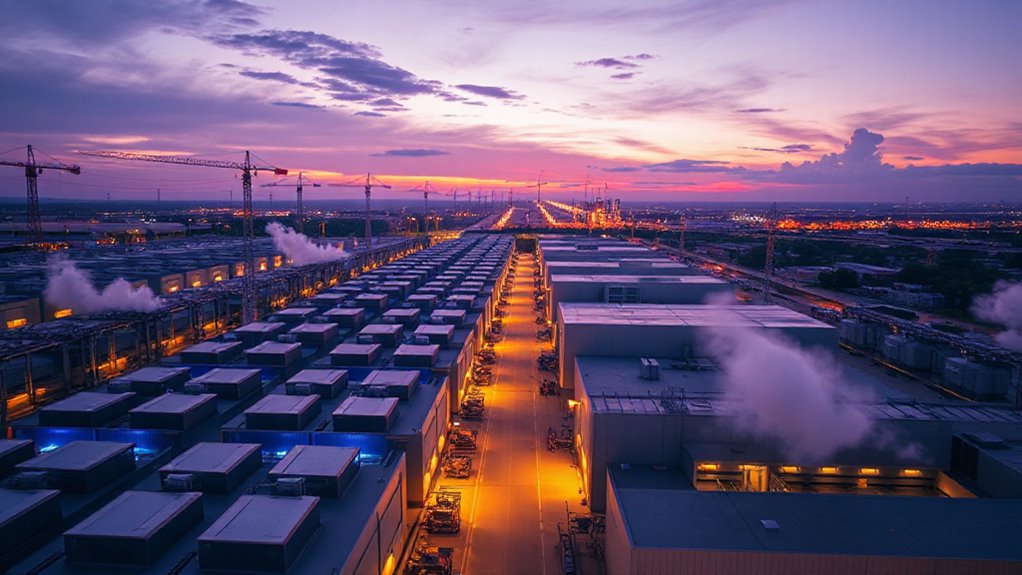
Microsoft’s artificial intelligence business is growing so fast that the company can barely keep up with demand. Azure, Microsoft’s cloud platform, jumped 40% in the first quarter and is expected to grow around 37% next quarter. The company isn’t limited by competition or lack of interest. Instead, they simply can’t build data centers fast enough to meet customer needs.
Microsoft’s AI growth isn’t constrained by competition—it’s limited only by how fast they can build infrastructure to meet demand.
The numbers tell a striking story. Microsoft plans to more than double its AI capacity this year after already increasing it by over 80% last year. They’re spending billions on new facilities, with property and equipment investments reaching $64.6 billion in fiscal 2025, up from $44.5 billion previously. Their data center footprint is expected to double within two years. That’s like building an entire second Microsoft infrastructure system from scratch in a remarkably short time.
Adoption across Microsoft’s products shows the same explosive pattern. About 900 million people use AI features in Microsoft products each month. Over 90% of Fortune 500 companies now use Microsoft 365 Copilot. GitHub Copilot alone supports 26 million developers and processed over 500 million pull requests in the past year. These aren’t small pilot programs. They represent fundamental shifts in how businesses operate. Central banks set policy rates that can influence the cost of capital for such large infrastructure builds, so companies watch policy interest rates closely as they plan investments.
The demand creates real physical challenges. Every megawatt of new computing power gets absorbed instantly. Data center electricity demand is projected to triple by 2035, jumping from 200 to 640 terawatt-hours annually. Microsoft is responding with massive projects like the Fairwater AI campus in Wisconsin, a 2-gigawatt facility coming online in 2026, and a new cloud region opening in Greater Atlanta Metro in early 2027. The company deployed its first large-scale NVIDIA GB300 cluster, marking a significant infrastructure milestone in meeting AI workload requirements. The pipeline includes dozens of hyperscale facilities totaling multiple gigawatts under construction across North America, Europe, Asia, and Latin America.
Financial results reflect this momentum. Operating margins reached 49% while free cash flow climbed to $25.7 billion, up 33%. Commercial remaining performance obligations increased 51% year over year. For skeptics questioning whether AI represents genuine business transformation or temporary hype, Microsoft’s capacity constraints provide a clear answer. Companies don’t spend billions doubling their infrastructure for passing trends. They do it when demand fundamentally exceeds supply.