
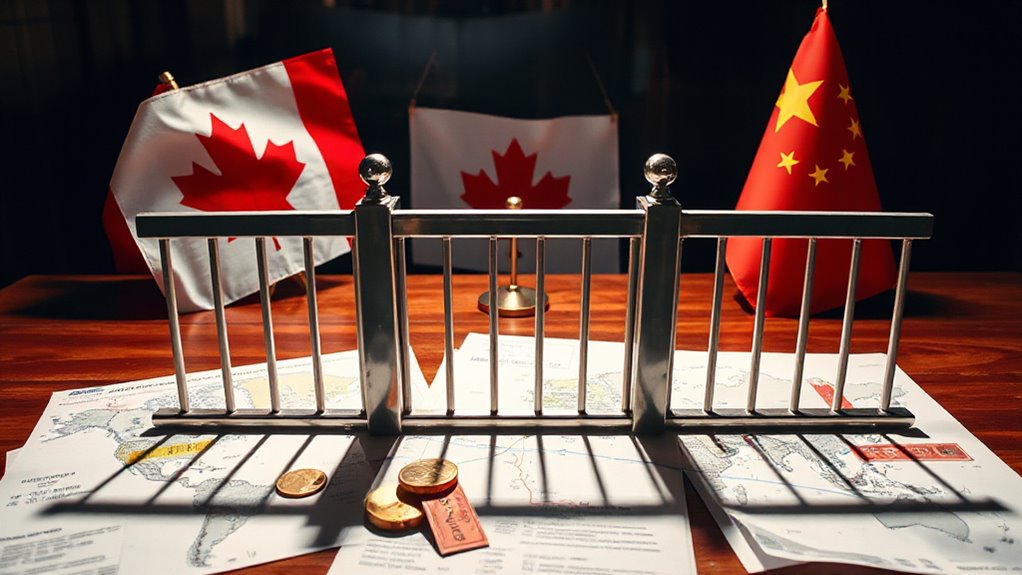
Former President Donald Trump issued a sharp warning to Canada on Saturday, threatening to impose a 100% tariff on all Canadian goods entering the United States if Prime Minister Mark Carney makes a trade deal with China. The threat came through Trump’s Truth Social platform, where he accused Carney of potentially turning Canada into a drop-off port for Chinese products seeking access to the American market.
Trump threatens 100% tariff on Canadian goods if Prime Minister Carney pursues trade deal with China, warning against drop-off port scheme.
Trump warned that China would “devour Canada” and destroy its businesses, social fabric, and way of life if such a deal went forward. He positioned his threat as necessary to protect U.S. manufacturing and national security from Chinese trade practices. The proposed tariff would effectively double the price of all Canadian imports immediately upon any China-Canada agreement.
This warning appears in Trump’s broader tariff strategy tracker dated January 24, 2026, alongside actions against other nations. His recent tariff moves include a 100% rate on Chinese-origin cranes and maritime equipment, plus steep increases on steel and aluminum. He has also raised tariffs on small-value Chinese goods from 90% or $75 per item to $150 per item. Trump previously threatened a rate increase on Canada’s fentanyl tariff by an additional 10% in October 2025.
Prime Minister Carney responded Sunday in Ottawa, emphasizing his commitment to protecting Canadians and their communities. He stressed that Canada respects its CUSMA trade commitments with the United States and Mexico. Many analysts warn that prolonged tariff conflicts can cause broader economic damage and lasting market volatility, particularly to affected industries and consumers, underscoring risks of a trade war.
Carney clarified that Canada recently pursued an electric vehicles agreement with China, not an all-encompassing free trade deal, and insisted this arrangement aligns completely with CUSMA requirements. The electric vehicles agreement aimed to resolve issues from recent years while maintaining Canada’s existing trade framework. Carney made clear that Canada has no intention of pursuing free trade with China, pushing back against Trump’s characterization of the situation.
The threatened tariff would have devastating consequences for Canada’s economy, potentially crippling the extensive bilateral trade between the two countries. Trump’s message framed the conflict as preventing Chinese dominance over Canada, though no specific ongoing China-Canada negotiations have been confirmed. The standoff highlights tensions between protecting North American trade relationships and managing economic ties with China. The diplomatic tensions escalated further when Trump revoked Carney’s invitation to join a presidential Board of Peace following Carney’s fiery Davos speech.