








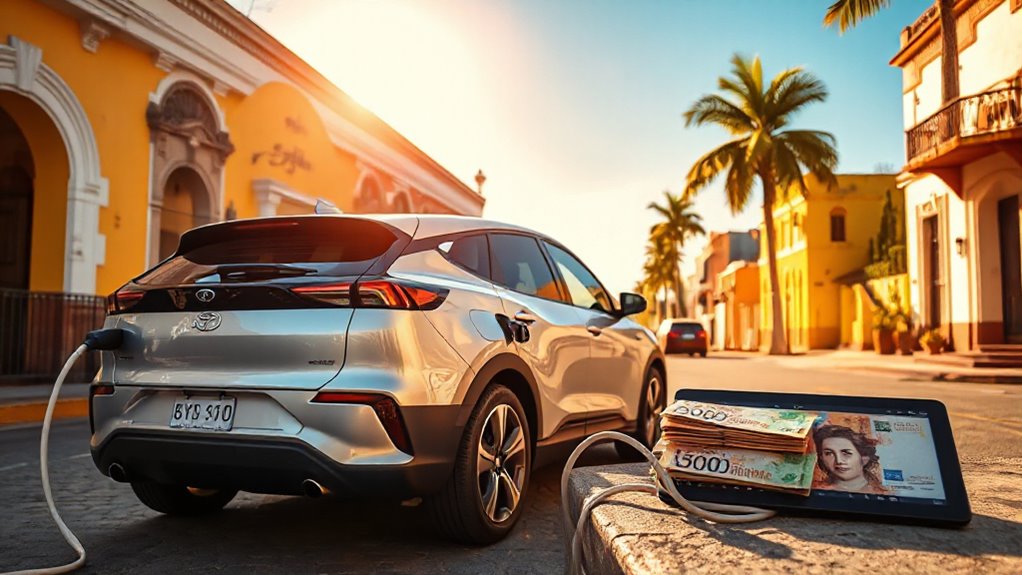
In Mexico‘s rapidly evolving car market, a Chinese company called BYD has taken the lead by doing something traditional automakers haven’t managed—selling electric vehicles that average families can actually afford. BYD now controls 70% of Mexico’s electric and plug-in hybrid vehicle sales as of 2025, a stunning achievement that has left competitors scrambling to catch up.
The numbers tell a remarkable story. Mexico became BYD’s largest overseas market, with 116,197 units exported from January to November 2025. That same year, BYD overtook Tesla as the world’s biggest EV seller globally. In Mexico specifically, Chinese electric and plug-in hybrid imports jumped from fewer than 500 units in 2021 to nearly 100,000 units in 2025. Investors also note that growth in the sector attracts interest across related industries like semiconductors and cloud services.
Price makes all the difference. BYD’s Dolphin Mini costs $2,000 less than the Chevy Spark EUV, its closest competitor. Meanwhile, Ford’s Mustang Mach-E costs $10,000 more in Mexico than in the United States. This pricing strategy targets developing economies where consumers are price-sensitive and infrastructure remains challenging.
BYD’s product lineup includes both battery electric vehicles and plug-in hybrids. Curiously, plug-in hybrids markedly outperform pure battery-electrics in Mexico because drivers appreciate range flexibility and conventional refueling convenience. From January to November 2025, BYD exported 71,395 plug-in hybrid vehicles to Mexico compared to 44,802 battery electric vehicles.
Traditional automakers seem caught flat-footed. Many consider Mexico too small a market or unprepared for new technology. Nissan stopped marketing its LEAF three years before 2025. GM manufactured EVs in Mexico but sold only 1,540 units locally in 2024. Tesla managed just 4,000 sales—roughly one-quarter of BYD’s electric vehicle numbers.
Mexico raised tariffs on Chinese-origin vehicles from 20% to 50% starting January 2026. BYD responded by ramping up shipments and running year-end promotions before tariffs took effect. The company plans to absorb tariff costs rather than raise prices dramatically. Despite these new barriers, sales aren’t expected to drop markedly because BYD vehicles remain competitively priced even with higher tariffs applied. BYD offered loans with interest rates as low as 7.9%, well below market averages of 13–14%. Canada reached an agreement with China to allow 49,000 Chinese EV imports with a tariff rate of 6.1% per year.