


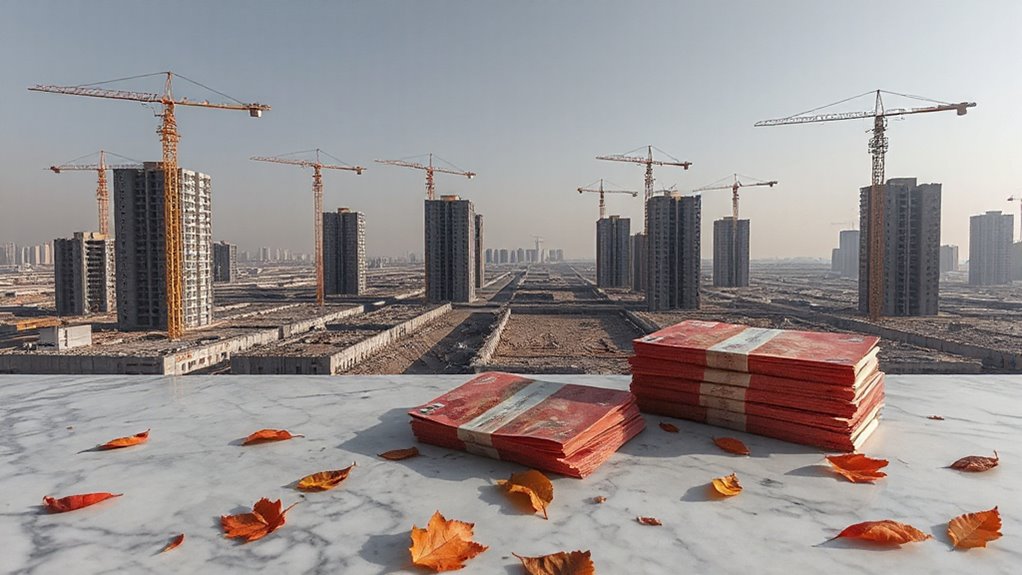
Where does one of the world’s largest real estate markets go when both prices and government support start disappearing? China’s housing sector is finding out the hard way as home prices tumble and Beijing pulls back from major rescue efforts.
New home prices across 70 Chinese cities dropped 2.4% compared to last year in November 2025, getting worse from October’s 2.2% decline. Think of it like a snowball rolling downhill – the momentum keeps building.
China’s housing market accelerates downward like a snowball gathering speed, with price drops worsening each month.
First-tier cities like Beijing and Shanghai saw prices fall 5.8%, while second and third-tier cities faced similar drops of 5.6% and 5.8% respectively.
The sales numbers tell an equally gloomy story. New home sales hit 814.5 million square meters in 2024, down 14.08% from the previous year. That’s like losing an area the size of several major cities worth of property transactions.
Construction has taken a beating too, with housing starts plummeting over 60% from pre-pandemic levels by 2023.
Beijing has tried various fixes, removing purchase restrictions and loosening mortgage rules in major cities. The government even allocated 4 trillion yuan in special loans to finish stalled projects – imagine thousands of half-built apartment buildings sitting empty like giant concrete puzzles missing their final pieces.
However, the central government stepped back from large-scale stimulus in the second half of 2025, leaving homebuyers wondering who will catch them if the market keeps falling.
Property investment dropped 14.70% in October 2025, while gross debt ballooned from 39.3% of GDP in 2014 to 88.3% in 2024. Buyers are increasingly shifting away from risky off-plan purchases, as the off-plan market share dropped from 90% in 2021 to just 67% by March 2025.
The downturn has been grinding on since mid-2021, creating a perfect storm of declining sales, cash-strapped developers, and falling prices. This represents the 29th consecutive month of price declines, highlighting the persistent nature of the housing crisis.
This mess has eroded household wealth and dampened spending, affecting China’s broader economy. During times of such economic uncertainty, investors often turn to gold allocation in their portfolios as a protective hedge against market volatility.
Looking ahead, experts predict tier-one cities might stabilize by 2026, but lower-tier cities face a longer struggle.
The IMF estimates resolving this crisis could require 5% of GDP over three years.
For now, Chinese homebuyers navigate an uncertain landscape where both market forces and government backing seem increasingly unreliable.
Related Posts