

Tesla stands at a crossroads where its ambitious plans for self-driving cars, humanoid robots, and artificial intelligence could hit a wall—not because the technology isn’t ready, but because there simply aren’t enough computer chips to go around.
Tesla’s chip shortage threatens to stall its AI ambitions despite having the technology ready to deploy.
The company faces what insiders call a “chip wall.” Current suppliers like TSMC and Samsung cannot keep up with Tesla‘s growing demands. Even with factories in Taiwan, Arizona, Korea, and Texas, there isn’t enough capacity. Tesla’s original four-fab plan still falls short, creating what Elon Musk sees as the company’s biggest challenge.
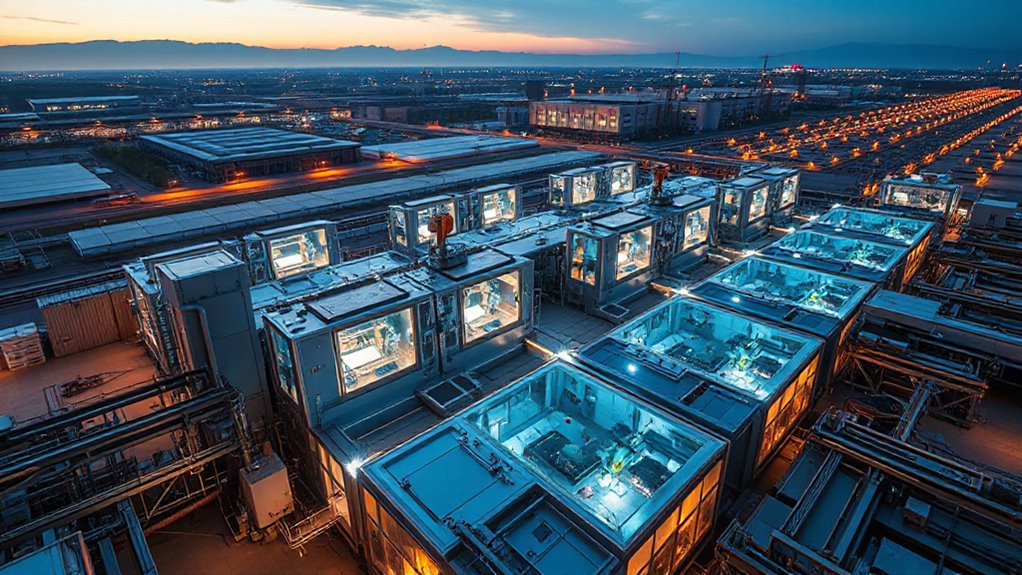
The solution? Build their own massive chip factory. Tesla is planning TeraFab, a gigantic facility in the United States that would be the largest and most advanced AI chip factory ever constructed. The facility would contain ten modules, each churning out 100,000 chips per month. That’s serious production power.
TeraFab would focus on making the AI5 chip and future generations like AI7, AI8, and AI9. The AI5 chip is particularly important right now. Mass production is targeted for 2027, with first silicon samples arriving in late 2026. Samsung’s Texas foundry is already testing special EUV equipment in March 2026 to prepare for AI5 manufacturing.
Timing matters because Tesla’s Cybercab production starts in April 2026 using the current AI4 chip, then switches to AI5. By 2028, the AI6 chip should double performance again. Musk has dedicated entire Saturdays for months working on AI5 development, showing how critical this chip is to Tesla’s future. The company aims to accelerate future chip design cycles to just nine months for AI7, AI8, and AI9.
Geopolitical risks add urgency to the plan. Depending on external fabricators limits supply and creates vulnerabilities. Vertical integration—making chips in-house—protects Tesla’s ambitions in autonomy, robotics, and artificial intelligence. It’s the same strategy Tesla used with Gigafactories for batteries. Tesla will not sell chips externally until internal demand is met from vehicles, Optimus robots, and data centers.
Tesla is exploring collaboration with Intel to make TeraFab happen. The company has already invested $2 billion into xAI for AI hardware and software development. This multi-billion-dollar facility represents a pivot from relying on others to controlling their own destiny in the AI race.
Central banks influence chip investment decisions through interest rate cycles that affect borrowing costs for large capital projects.
Related Posts