






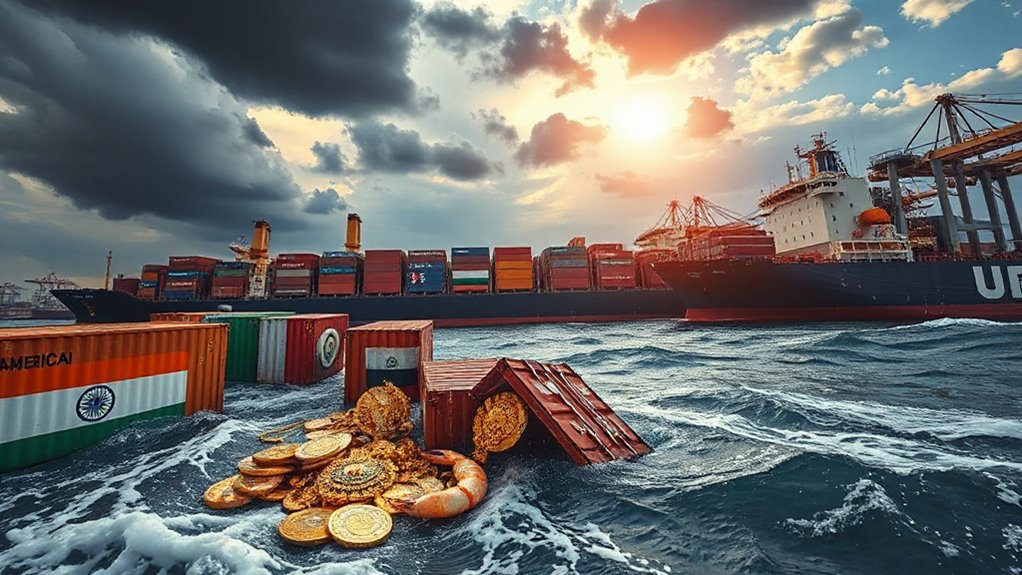
A dramatic shift in trade winds has left Indian exporters scrambling for new destinations as hefty US tariffs slam the brakes on what was once a thriving business relationship.
Between May and October 2025, India’s exports to America plummeted by 28.5%, dropping from $8.83 billion to $6.31 billion as tariffs climbed to a staggering 50%.
The August 27 tariff implementation hit like a freight train, with September and October data revealing the full damage.
Gems and jewelry exports took the hardest punch, falling 76% in September compared to the previous year.
Meanwhile, shrimp exporters—who typically send 65% of their $4.88 billion worth of seafood to American tables—found themselves in particularly choppy waters due to razor-thin profit margins.
But Indian businesses proved surprisingly nimble, pivoting faster than trade experts anticipated.
Like water finding new channels, exporters quickly redirected their goods to Asia, the Middle East, and Europe.
The UAE became a golden destination with gem and jewelry exports surging 79%, while Hong Kong and Belgium saw increases of 11% and 8% respectively.
Container shipping data tells the same story of rapid adaptation.
US-bound volumes from India dropped 18.4% in October, while countries like Indonesia, Thailand, and Vietnam enjoyed positive growth.
Some traders got creative, using intermediate countries as stepping stones—importing from India then re-exporting to America.
The competition isn’t sitting idle, though.
Indonesia and Ecuador enjoy much friendlier US tariffs of just 19% and 15%, allowing them to snatch market share and raise their prices.
It’s like playing musical chairs, and some seats have definitely switched hands.
Even products in tariff-exempt categories like smartphones and pharmaceuticals couldn’t escape the broader trade turmoil, experiencing a 25.8% decline despite their protected status.
Recognizing the urgency, India’s government rolled out a massive ₹45,060 crore support package, including ₹20,000 crore in credit guarantees.
Small and medium enterprises face particularly difficult challenges as MSMEs struggle with slower adaptation compared to their larger counterparts who can more easily pivot to new markets.
Officials estimate that only $2 billion of the usual $8 billion in annual US exports can realistically find new homes.
The trade disruption has also triggered currency exchange volatility as capital flows shift away from traditional US-India trade routes toward emerging markets.
Despite the American headwinds, this forced diversification might ultimately strengthen India’s global trade position.
Sometimes the most challenging storms push ships toward better harbors, and Indian exporters seem determined to prove that adaptability trumps adversity.
Related Posts