


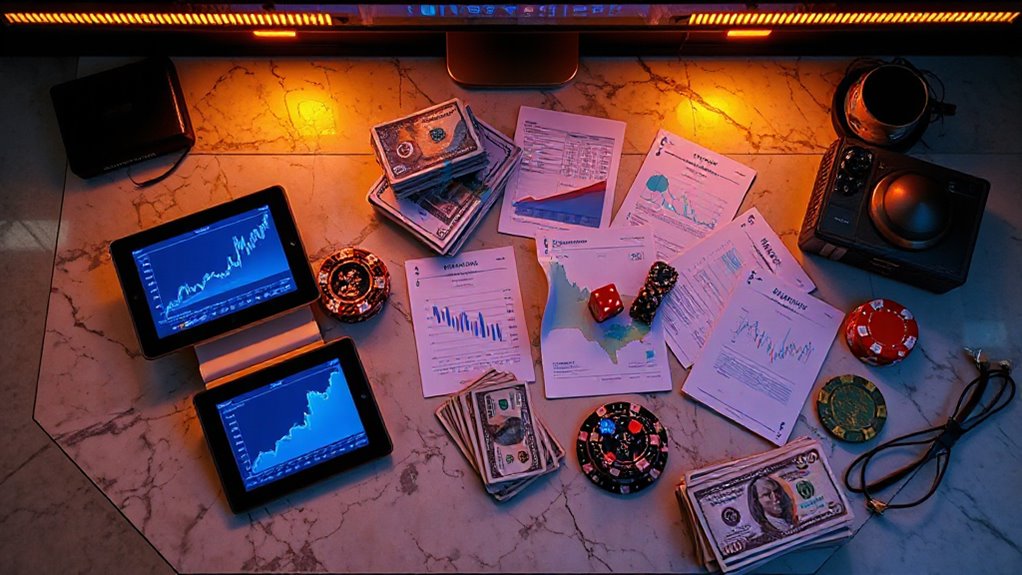
What happens when Wall Street’s number-crunching meets Vegas-style betting? The answer is prediction markets, and they’re lighting up America’s financial landscape like never before. These fascinating platforms let traders buy and sell contracts based on future events, creating a unique blend of serious finance and educated gambling.
Think of prediction markets as living, breathing fortune tellers with money on the line. Unlike static polls that capture a moment in time, these markets update constantly as new information flows in. When traders put real cash behind their beliefs, they tend to think more carefully about their predictions. It’s amazing how quickly people become experts when their wallets are involved.
Money makes everyone a prophet when real dollars back their predictions.
This concept isn’t exactly new. From 1884 to 1940, New York betting markets accurately forecasted presidential elections with impressive precision. The New York Times even declared in 1924 that “Wall Street betting odds never wrong.” These historical markets handled betting volumes over 200 times larger than modern academic experiments, proving that big money and accurate predictions often go hand in hand.
Today’s prediction markets consistently outperform traditional polls and expert forecasts. During the 2024 election, Polymarket bettors proved more accurate than pollsters when predicting Electoral College outcomes. The secret sauce lies in financial incentives that reward correct predictions and punish wrong guesses.
Major news outlets are taking notice. CNN now displays real-time odds from Kalshi, a federally regulated prediction market exchange, right in their programming banners. This shift from fintech fringes to mainstream financial coverage signals something big is happening. Advanced machine reading capabilities now analyze vast amounts of text data to identify economic patterns that influence market movements.
Research shows these markets work especially well for short-term events. Wall Street Journal articles from 1984 to 2017 successfully predicted 25% of stock market fluctuations, while hybrid models combining Google Trends with trading data outperformed single sources. Sophisticated forecasting systems now integrate Internet search behaviors with traditional financial data to capture market sentiment in real-time. Successful participants often focus on proven strategies that emphasize patience and analysis over speculative trading approaches.
However, these markets aren’t perfect crystal balls. They tend to overprice unlikely outcomes and struggle with long-term predictions beyond one year. Still, as billions flow into this emerging asset class, prediction markets are transforming how America processes information and makes financial decisions.
Related Posts