





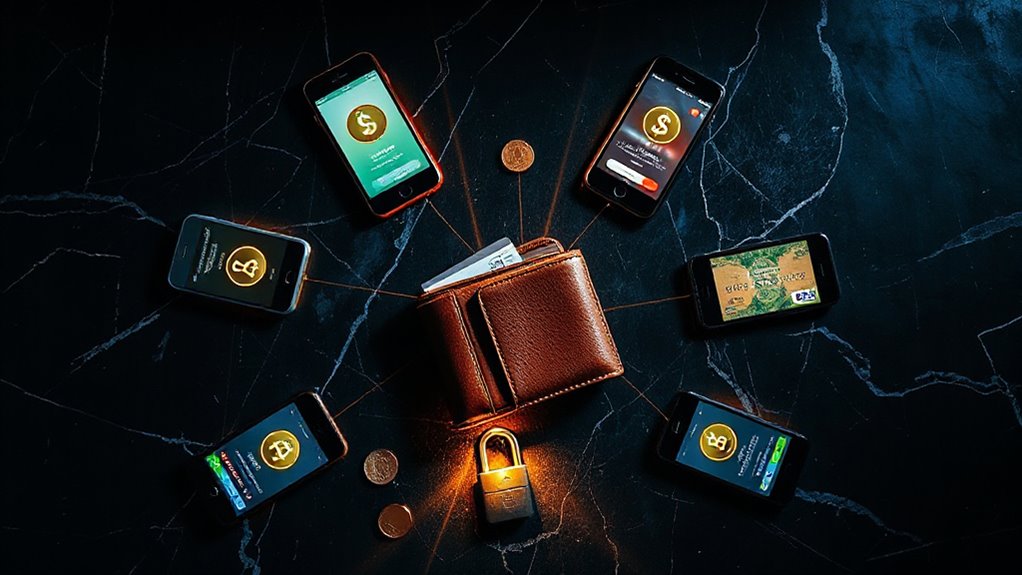
How did paying for things become as simple as tapping a phone? Digital wallets quietly transformed from a cool tech gadget into something nearly half the world now uses daily. By 2025, experts predict 4.8 billion people will rely on these invisible payment systems, making digital wallets more common than traditional bank accounts in many regions.
Digital wallets evolved from novelty gadgets to essential tools that billions now use more than traditional banking.
The numbers tell a fascinating story about our changing relationship with money. In America, 56% of consumers now use digital wallets monthly, with younger generations leading the charge. Millennials and Gen Z make up three-quarters of all users, though older adults are catching up surprisingly fast.
Even grandparents are discovering the convenience of Apple Pay at grocery stores.
This shift represents more than just convenience—it’s reshaping global commerce. Digital wallet transactions hit $10 trillion in 2024 and could surge past $17 trillion by 2029. That’s roughly equivalent to the entire U.S. economy flowing through smartphone screens.
People using digital wallets spend considerably more than those using cash or cards, suggesting these tools somehow make spending feel easier. Remarkably, over half of digital wallet users have stopped shopping at merchants that only accept traditional payments.
The competition for digital wallet dominance reveals interesting power dynamics. Apple Pay leads American markets with 65.6 million users, nearly doubling Google Pay‘s reach. Meanwhile, Chinese platforms like Alipay and WeChat Pay process billions of daily transactions across Asia.
Each company controlling these payment rails gains unprecedented insight into consumer behavior and spending patterns.
Security concerns that once held people back are fading. Worries about mobile wallet safety dropped from 25% to 21% between 2021 and 2022 as users experienced the technology’s reliability firsthand.
Advanced encryption and biometric authentication make digital wallets often safer than physical credit cards. Biometric authentication is projected to reach 75% global adoption by 2023, with the U.S. leading in fingerprint access.
The real power lies not in the technology itself but in who controls these digital highways. Companies managing our payment flows gain access to invaluable data about where we shop, what we buy, and how we live. Just as machine learning tools analyze historical data to predict market movements, payment companies use transaction patterns to forecast consumer behavior and market trends.
As digital wallets prepare to handle over half of all e-commerce transactions by 2025, the organizations controlling these systems will shape tomorrow’s economy. Your wallet choice today determines which companies influence your financial future.
Related Posts