










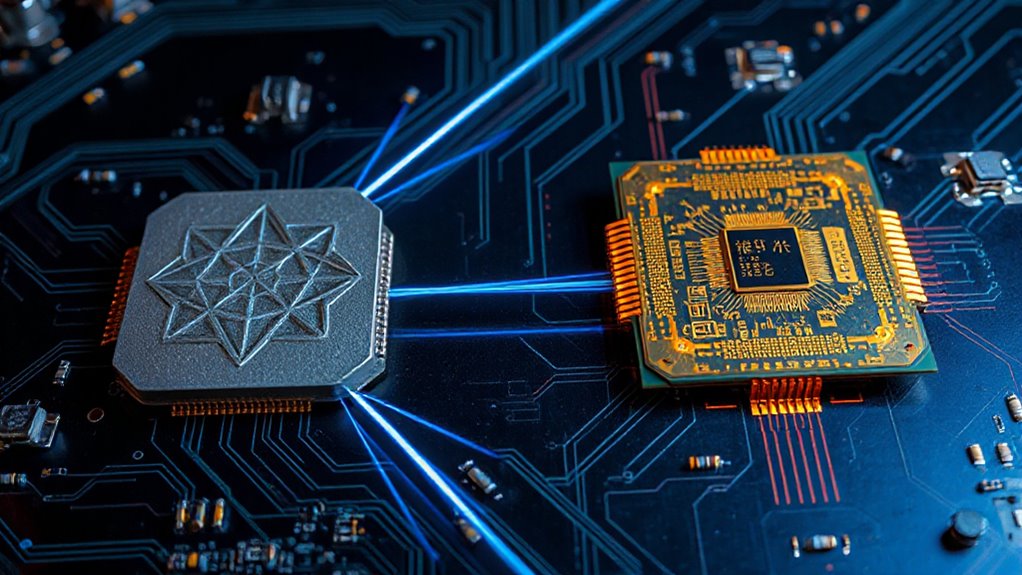
While tech giants battle for artificial intelligence supremacy, China’s Baidu just revealed two powerful new computer chips that could shake up the global AI landscape. The company disclosed the M100 and M300 processors at their recent Baidu World conference, marking a significant step toward reducing China’s dependence on foreign technology.
Baidu’s M100 and M300 processors represent China’s bold push for AI chip independence amid escalating tech competition.
The M100 chip, designed by Kunlunxin Technology, focuses on making AI models run more efficiently using something called mixture-of-experts technique. Think of it like having multiple specialists working together instead of one person doing everything.
Meanwhile, the M300 targets an even bigger challenge: training massive AI models with trillions of parameters. These chips won’t hit the market until 2026 and 2027 respectively, but they represent years of development since Baidu started chip work in 2011.
China has strong motivation for creating homegrown processors. US export controls have made it harder for Chinese companies to buy advanced chips from companies like Nvidia. This push for technological self-reliance means Chinese firms want their own reliable, cost-effective computing power without depending on imports. These investments in chip development demonstrate how Baidu allocates its retained earnings toward strategic growth rather than distributing all profits as dividends.
Baidu isn’t stopping at individual chips. They’re building massive computing systems called Tianchi that connect hundreds of processors together. The Tianchi256 links 256 chips while the Tianchi512 doubles that number.
These cluster systems can boost performance by over 50% compared to previous versions, creating computing environments powerful enough for the most demanding AI tasks.
The competitive landscape includes other Chinese chip makers like Huawei, Cambricon Technologies, and Biren Technology. Each company is racing to build domestic alternatives to Western hardware dominance. These domestic chips provide powerful, low-cost, and controllable AI computing capabilities for Chinese companies.
However, Baidu’s announcements significantly avoided direct comparisons to industry leaders like Alphabet’s TPUs or Nvidia’s latest offerings.
Whether these chips can truly threaten Alphabet’s AI dominance remains uncertain. The timeline shows China still lags behind Western leaders by several years. Baidu also presented an improved Ernie model with enhanced capabilities across text, image, and video analysis.
While the new processors address domestic needs amid geopolitical tensions, limited evidence suggests they’ll surpass current AI hardware champions.
Still, Baidu’s bold chip leap represents a meaningful challenge that could reshape global AI competition in unexpected ways.