
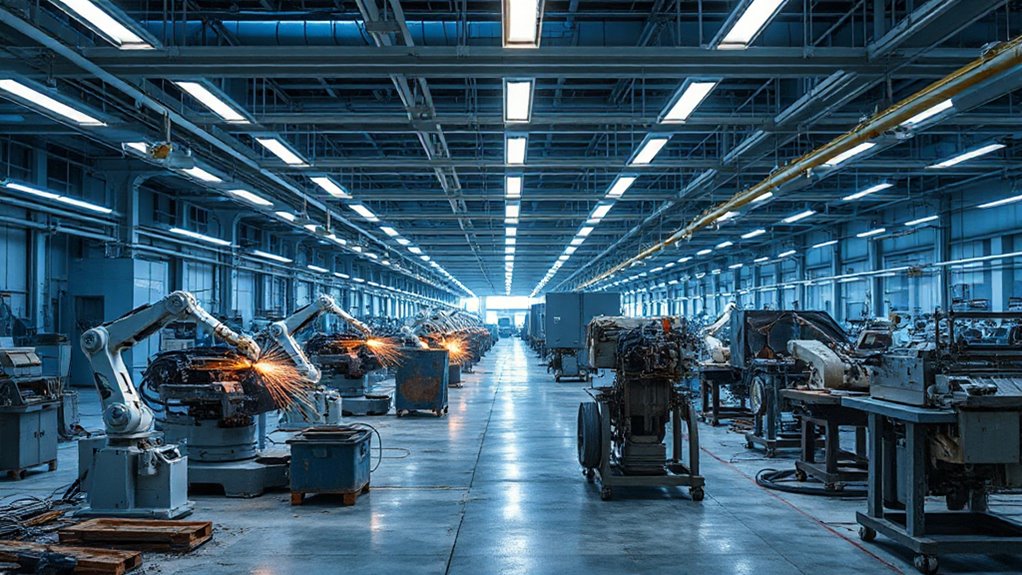
Why Low-Value Manufacturing Is Losing Its Economic Edge
Low-value manufacturing is losing its competitive edge, and the reasons are not hard to see. Think of it like a lemonade stand trying to compete when lemons suddenly cost twice as much. Rising wages make cheap production expensive. Automation replaces workers with machines so factories need fewer people. Countries that once made simple goods cheaply are now chasing smarter and more profitable industries. Meanwhile other lower-cost countries are undercutting prices.
Low-value manufacturing used to be a reliable economic engine but today that engine is running out of fuel and something faster is taking its place. Nearly 70,000 factories closed in the United States between 1998 and 2020, reflecting how dramatically the landscape of manufacturing has already shifted across even the world’s largest economies. The broader consequence of this decline is stark, as China now holds 31% of world manufacturing output while the United States accounts for just 16%. Policymakers and investors are responding by shifting capital toward defensive sectors and higher-quality industries to bolster resilience.
The Numbers Behind China’s High-Tech Manufacturing Surge
While the old engine of cheap manufacturing sputters, a newer and faster one is clearly revving up.
The old engine of cheap manufacturing is sputtering. A newer, faster one is already roaring to life.
China’s high-tech manufacturing grew 9.5% in early 2025, easily outpacing broader industrial growth. The product numbers tell an even wilder story:
- Industrial robots output jumped 35.6%
- New energy vehicles surged 36.2%
- Civilian drones soared 53.7%
- 3D printing devices climbed 43.1%
These aren’t small bumps. They’re full sprints. Profits followed too.
Smart devices posted 81.6% profit gains in September 2025. Electronic components rose 39.7%.
China isn’t just making more things. It’s making smarter things and earning more doing it. Optical and precision instruments recorded profit increases of 45.2% and 17.5% respectively, underscoring how gains are spreading across technology-intensive niches.
Aerospace equipment profits climbed 11.3% in September, reflecting how high-tech upgrades are generating real surplus gains across strategically critical manufacturing sectors.
Meanwhile, many firms use futures contracts to hedge input costs and stabilize margins in volatile commodity markets.
Which Sectors Are Actually Driving the Growth
Behind China’s manufacturing surge, several sectors are doing the heavy lifting. Clean energy leads the pack. Investments jumped 40% in one year reaching about US$890 billion. Electric vehicles, lithium-ion batteries, and solar cells form the core “new three” cluster driving this momentum. Think of them as China’s economic MVPs right now.
Meanwhile industrial output grew 6.1% in early 2024 showing manufacturing still has real muscle. Exchange-traded funds have made it easier for global investors to gain exposure to these industrial winners. Semiconductors and automation are gaining ground too. Services also matter adding over 54% of GDP. Together these sectors are replacing old low-cost factories with smarter higher-value industries built for long-term growth. Agricultural market output is projected to reach US$1,682 billion by 2028, reflecting a compounding growth rate that signals the sector’s expanding role alongside these emerging industries.
China’s real estate sector, once contributing as much as roughly 20% of economic output, has seen property prices decline for eight consecutive months as of February 2024, underscoring how dramatically the country’s growth drivers have shifted away from property toward technology and clean energy.
How China’s Smart Factories Are Compressing Production Cycles
- Product development cycles are 28.4% shorter
- Production efficiency is 22.3% higher
- Defect rates dropped 50.2%
- Carbon emissions fell 20.4%
How? AI inspection removes slowdowns. Digital design tools speed up testing. Smart warehousing keeps materials moving. Real-time data catches errors instantly. Excellence-level factories have implemented nearly 2,000 advanced scenarios to push these gains even further. Institutional platforms enable ultra-low latency connections that help synchronize automated production and supply-chain systems.
What Could Slow China’s High-Tech Manufacturing Momentum?
Even the fastest machine in the world can hit a speed bump. China’s high-tech push faces real challenges worth watching.
Factories are producing more than buyers can absorb creating dangerous oversupply. Monetary policy constraints and changing interest rates can also reduce demand and investment, deepening inventory gluts. Trade restrictions block access to advanced chips and key equipment slowing progress.
Many industries still depend heavily on imported parts despite large research budgets. Local governments pile on debt funding duplicate projects that weaken overall returns.
Meanwhile productivity growth has stalled meaning bigger output does not always mean smarter output. These pressures do not stop momentum entirely but they definitely make the road bumpier. Total factor productivity growth has stagnated over the past decade even as China expanded its share of global manufacturing.
High-tech manufacturing accounted for less than 20% of total industrial output yet contributed 32.6% to overall industrial growth in Q1, meaning the broader economy still leans heavily on sectors that may not sustain this pace.