






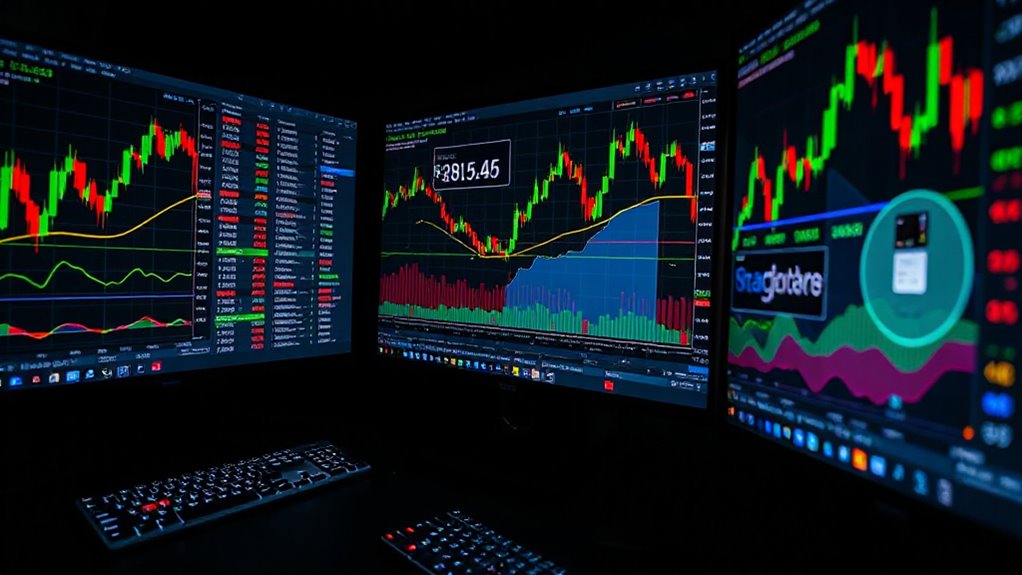




How did retail investors go from chasing meme stocks to becoming serious market players almost overnight? The answer lies in 2025’s remarkable transformation of everyday trading into a sophisticated rebellion against traditional Wall Street wisdom.
Retail traders ditched meme stock chaos for data-driven strategies, transforming overnight into sophisticated players who outmaneuvered traditional Wall Street.
This year marked the highest retail trading activity ever recorded, surpassing even the legendary GameStop peak of 2021. Activity jumped 50% compared to 2024, fueled by wild market swings that saw the S&P 500 tumble nearly 20% from February to early April.
But here’s the twist: instead of panicking, retail traders got smarter.
Gone were the chaotic days of meme stock madness. Retail investors embraced data-driven strategies, using AI tools and algorithmic trading like seasoned professionals. They tracked short interest and sentiment metrics with laser focus.
When Kohl’s stock surged 90% in June, it wasn’t luck – it was careful analysis. Opendoor’s stunning 440% rally came after retail traders spotted hedge fund endorsement patterns.
The year featured three major dip-buying opportunities that separated the pros from the amateurs. The DeepSeek AI announcement in January triggered a sell-off in US tech stocks, creating a perfect buying moment.
March brought a momentum unwind, and April delivered the S&P 500’s worst single day in five years following tariff announcements. Smart retail traders positioned themselves perfectly for each bounce.
ETFs became the weapon of choice, capturing 75% of retail inflows. Day traders discovered that diversified funds offered better risk management than individual stocks. However, recent market weakness has pushed many day traders to become net sellers due to mounting valuation concerns. Nvidia and Tesla still attracted massive retail flows, but investors balanced these bets with systematic approaches.
The macro environment created perfect conditions for this retail rebellion. Supply chain chaos and hourly policy changes left even CEOs unable to forecast quarterly results. Investors increasingly turned to ESG-compliant assets as sustainable investing captured 42% of retail portfolios, emphasizing responsible growth over speculative gains.
While corporate America struggled with uncertainty, nimble retail traders adapted quickly to changing conditions.
Consumer behavior shifted dramatically as volatility reached unprecedented levels. Mobile commerce captured over 56% of online sales, and holiday promotions started in September as retailers scrambled to capture spending before confidence eroded further. Meanwhile, the Bitcoin mining process continued operating at over 1 trillion terahashes per second, maintaining its decentralized security even amid market turbulence.
The retail rebellion proved that with the right tools and mindset, everyday investors could not only compete with Wall Street but often outperform the professionals who underestimated their evolution.