




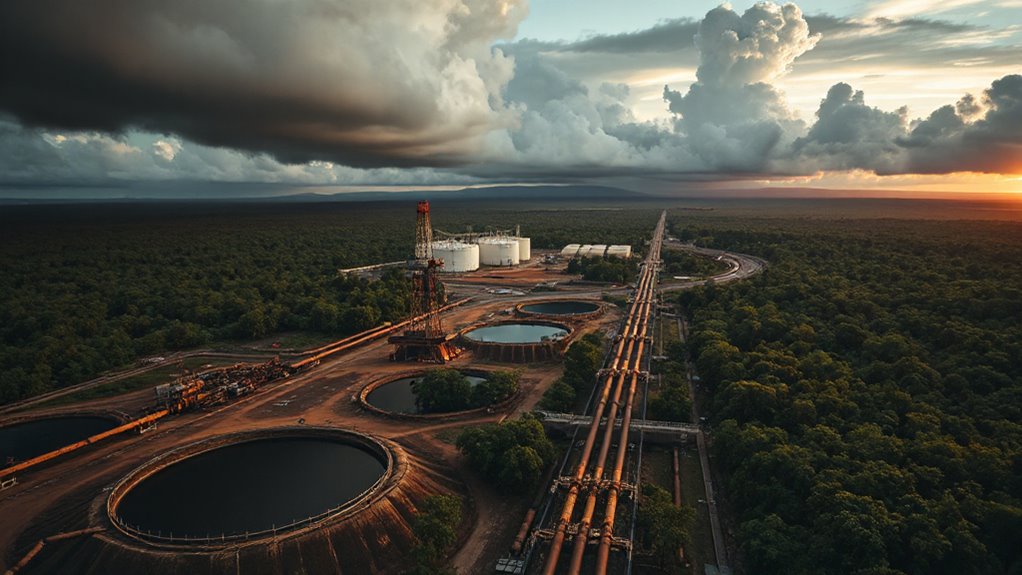
Venezuela sits on a treasure chest of oil—303 billion barrels of proven reserves, more than any other country on Earth, even surpassing the vast fields of Saudi Arabia. This staggering number tripled from roughly 100 billion barrels in the early 2000s to around 300 billion by the late 2000s. The jump came mainly from reclassifying heavy oil in the Orinoco Belt as “proved reserves” rather than from discovering new fields or ramping up production.
Most of Venezuela‘s oil is extra-heavy crude, which is harder and more expensive to extract than lighter types. Pulling this thick oil from the ground requires foreign technology, capital, and special chemicals called diluents. It’s like trying to sip a milkshake through a narrow straw—possible, but requiring extra effort and the right tools. The extra-heavy oil in the Orinoco Belt is associated with low recovery rates, making extraction even more challenging.
Since 2017, the United States has imposed tough sanctions on Venezuela’s oil sector, targeting PDVSA, the state oil company, and choking off exports and financial deals. These sanctions serve as political leverage, pressing Venezuela’s government to make concessions and agree to elections. U.S. officials have repeatedly described Venezuela’s reserves as a potential alternative to Middle Eastern and Russian oil in global energy planning.
During the Trump administration, a “maximum pressure” campaign aimed to force regime change in Caracas. The U.S. recognized an opposition leader as Venezuela’s legitimate president and cut off access to Gulf Coast refineries that historically relied on Venezuelan heavy crude. Senior officials openly discussed the strategic importance of keeping Venezuela’s oil away from rivals like China and Russia while securing supplies for U.S. companies and allies.
American corporation Chevron has long operated in Venezuela, holding stakes in Orinoco Belt projects. Even under strict sanctions, Chevron received limited licenses to maintain its presence and protect future production potential. Trump-era policy explicitly tied possible sanctions relief and asset unfreezing to political change, suggesting that a friendly government could open access to Venezuela’s oil wealth. President Trump stated his intent to invite American companies to invest in rebuilding Venezuela’s oil industry after a military operation that captured Nicolás Maduro. This approach has turned Venezuela’s vast reserves into a geopolitical bargaining chip, affecting relationships across continents.
Several analysts noted that tapping these reserves would likely require foreign capital and long-term investment to overcome technical and financial hurdles.