






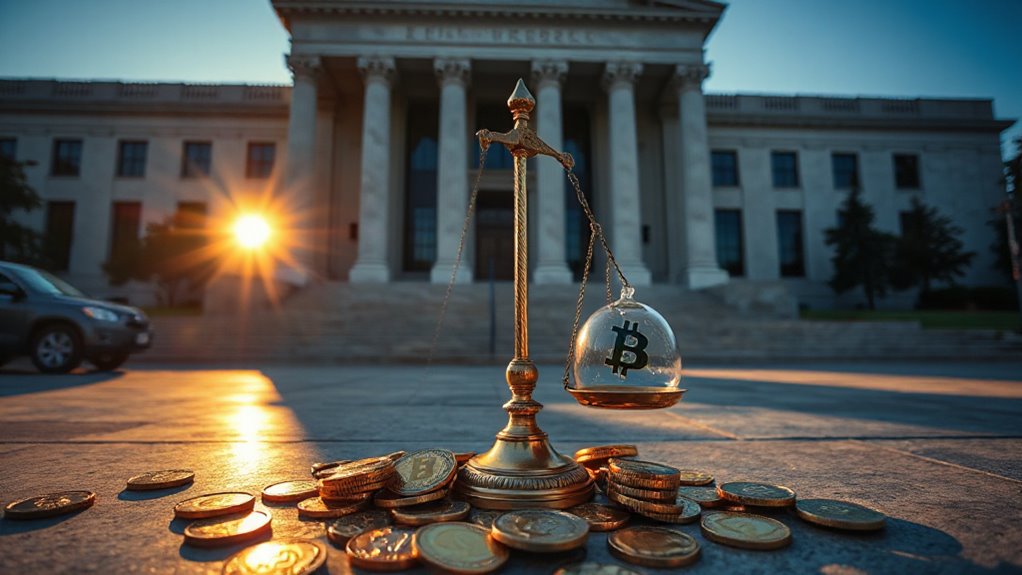
Beneath the surface of Bitcoin’s recent tumble from its October peak of $126,000 to under $70,000 lies a familiar culprit: the Federal Reserve’s monetary policy decisions. While headlines focus on market sentiment and trading volume, the real story unfolds in the quietly powerful meetings where central bankers adjust interest rates and reshape the financial landscape.
Behind Bitcoin’s dramatic $56,000 drop sits an invisible hand: Federal Reserve policy quietly reshaping the entire financial landscape.
The Fed’s upcoming January 27-28, 2026 meeting carries a 96% probability of holding rates steady. History suggests caution for Bitcoin holders, as 75% of past FOMC meetings have triggered corrections in cryptocurrency prices. These aren’t random coincidences. When the Fed maintains hawkish language or keeps rates elevated, investors typically retreat from riskier assets like Bitcoin and return to safer bonds and traditional investments. Central banks set the policy interest rate that ultimately anchors borrowing costs across the economy, influencing investor behavior toward riskier asset classes like crypto and equities policy interest rate.
Interest rate mechanics work like a seesaw. Low rates make bonds less attractive, pushing investors toward higher-risk opportunities including cryptocurrencies. High rates flip the equation, raising borrowing costs and constraining the leverage that fuels speculation. A strong dollar resulting from hawkish Fed policy also pressures Bitcoin, which trades primarily in U.S. currency.
Recent examples illuminate this pattern clearly. September 2024‘s 50-basis-point cut lifted Bitcoin 8% as cheaper money flooded into risk assets. Conversely, November 2022‘s 75-basis-point hike amid 7.1% inflation sent Bitcoin plummeting 15%. The emergency 2020 rate cuts under similar logic expanded liquidity dramatically, creating conditions for substantial Bitcoin gains. Rate tightening beginning in March 2022 brought sustained volatility and downward pressure on Bitcoin as monetary conditions tightened.
Looking ahead, March 2026 shows a 52% probability of rate cuts, while policy rates should drift toward the low 3% range by year-end. Powell’s term expires in May 2026, introducing uncertainty about future Fed leadership and liquidity policies. Quantitative tightening continues pulling money from the economy, creating headwinds for cryptocurrency valuations. The rate decision announcement will occur on January 28 at 2:00 PM ET, followed by a press conference at 2:30 PM that historically proves more market-moving for crypto than the decision itself.
The current environment presents mixed signals. Crypto sentiment hovers near all-time lows with prices down over 20% year-to-date. Yet potential catalysts remain, including possible Fed rate cut signals and institutional adoption. If just 1% of institutional money flowed into crypto, it could generate $2 trillion in new investment. For now, though, monetary policy rather than hype determines Bitcoin’s trajectory.