










In the early hours of February 28, 2026, the United States launched Operation Epic Fury, sending waves of aircraft and missiles toward Iran in what would become one of the largest military operations in recent history.
Over 3,000 strikes targeted Iranian military sites across at least nine cities, focusing on ballistic missile facilities and nuclear capabilities. The massive campaign involved precision weapons ranging from 500-pound bombs to 2,000-pound penetrator munitions designed to reach deeply buried targets.
The assault deployed thousands of precision munitions against hardened underground facilities housing Iran’s most dangerous weapons programs.
Working closely with Israel, US forces systematically dismantled Iran’s ballistic missile industrial base and neutralized its naval forces. The attack date had been agreed upon two weeks earlier during Israeli Prime Minister Netanyahu’s visit to Washington. President Trump approved the operation and later announced it in a video urging Iranians to rise up against their government. Tragically, Supreme Leader Ali Khamenei was killed during the strikes.
Iran responded with approximately 35 missiles fired at Israel and attacks on 14 US bases across Bahrain, UAE, Kuwait, Jordan, and Saudi Arabia. The Islamic Revolutionary Guard Corps vowed to continue fighting until both the US and Israel were defeated. Despite initial cyber operations that degraded Iranian command systems, the conflict showed no signs of quick resolution.
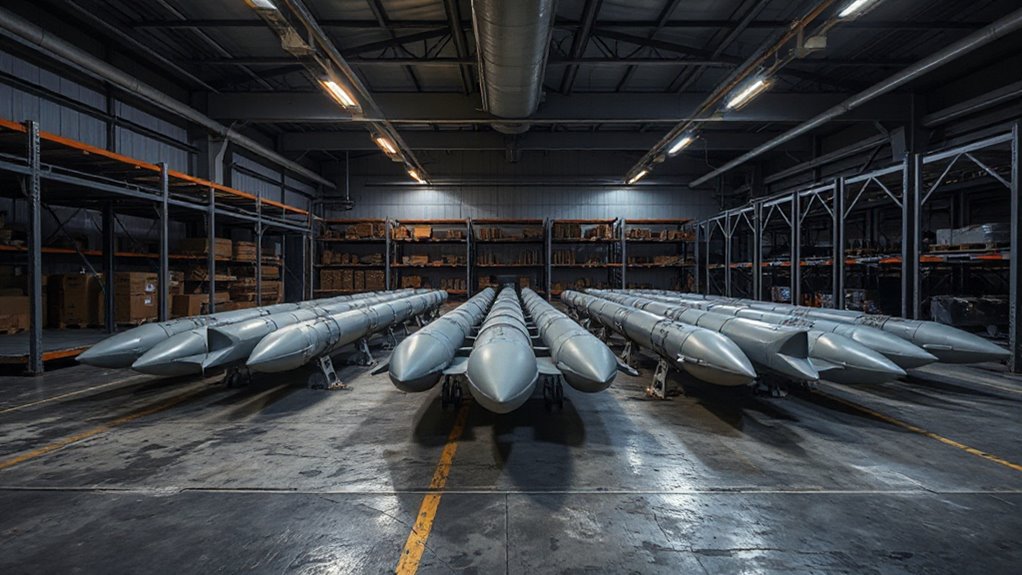
Now the White House faces a critical challenge: replenishing ammunition stockpiles. The operation consumed enormous quantities of JDAMs and Hellfire missiles, with US forces hitting 43 ships and hundreds of military sites in less than one week. President Trump indicated operations would last weeks, requiring sustained firepower.
Defense officials are pressing weapons manufacturers to accelerate production. Think of it like a garden hose running at full blast—eventually the water tower needs refilling. The Pentagon must balance continuing strikes with maintaining readiness for other potential conflicts.
Public opinion remains divided, with 47 percent opposing the strikes. As operations progress to the next phase of dismantling Iranian capabilities, the pressure on defense contractors grows. The question isn’t just about winning this fight but ensuring America has enough munitions for whatever comes next. That’s a tall order requiring factories to work overtime.
Central bank decisions on interest rates can indirectly affect defense production by influencing borrowing costs and the attractiveness of cash versus long-term investment in manufacturing capacity, a factor policymakers are watching closely for its impact on real interest rates and industrial financing.