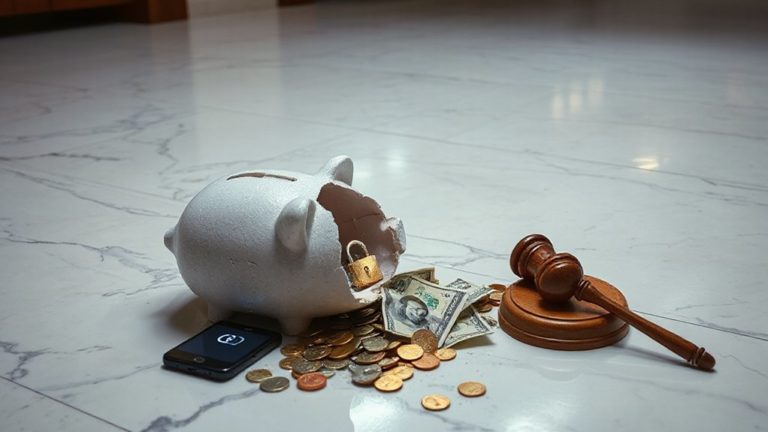











The Four Projects Behind Trump’s $2.3 Billion Crypto Operation
Between 2024 and 2025, the Trump family built a crypto empire worth an estimated $2.3 billion across four separate ventures. Think of it like four different stores in one very profitable mall.
Between 2024 and 2025, the Trump family quietly assembled a crypto empire valued at an estimated $2.3 billion.
First came World Liberty Financial, a decentralized finance platform launched in fall 2024. The platform capitalized on rising institutional interest and tokenization trends that expanded access to real-world asset investments.
Next was the $TRUMP memecoin, a branded digital coin that soared then crashed hard.
Third was ALT5 Sigma, later rebranded as AI Financial Corp.
Finally, American Bitcoin, a mining operation linked to Hut 8, rounded out the portfolio.
Each project leaned heavily on branding and licensing rather than risking the family’s own money. That total of $2.3 billion exceeds Coinbase’s profit of approximately $2.1 billion over the same period. Notably, Reuters estimated that investor losses across these same projects reached roughly $2.3 billion, mirroring the scale of the family’s gains.
How the Trump Family Extracted $2.3 Billion From Token Sales
The Trump family did not simply wait for people to discover their crypto projects and hope for the best.
They built a careful system to lock in profits early.
Their “Gold Paper” document guaranteed them 75% of every dollar raised through World Liberty Financial.
Family-linked entities received billions of tokens before regular buyers could even log in.
Early private buyers got discounts too but insiders kept the biggest slice.
Trading fees from the $TRUMP memecoin flowed straight back to family accounts.
The whole structure meant profits arrived automatically while outside investors absorbed most of the risk.
World Liberty Financial ultimately raised approximately $1.4 billion from the sale of 30 billion governance tokens, with nearly $987 million estimated to have flowed directly to family-linked entities after expenses.
The WLFI governance token, which began at around $0.31, has since fallen to $0.05, leaving most retail holders with steep losses while the family’s revenue was locked in through upfront token sale proceeds.
Many retail investors were left exposed while insiders prioritized diversification across sectors to protect their gains.
Why Over a Million Investors Lost While Trump Promoters Profited
When a new investment gets promoted by a famous person, it is easy to feel like missing out would be a huge mistake. With Trump-branded tokens, that feeling cost many people real money. Insiders held most of the supply and sold early. Regular buyers entered late and lost value fast.
- Insiders kept 80% of $TRUMP tokens while retail buyers got 20%
- Early sellers cashed out before prices dropped
- Marketing used political loyalty instead of honest risk warnings
- Complex fee structures quietly moved money toward promoters
The game was designed before most players even sat down. Reuters found the Trump family and associated entities generated more than $600 million from the $TRUMP meme coin alone, while many investors suffered sharp losses as the token collapsed from its peak.
Across all four ventures, the deal structure followed the same playbook: little or no capital upfront, heavy promotion, and rich licensing or revenue shares that rewarded insiders regardless of what happened to prices. Direct market access and privileged liquidity arrangements allowed insiders to execute large trades quickly, deepening the disadvantage for late retail buyers. Ethics experts told Reuters that a sitting president holding such a deep financial stake in a regulated industry is historically unusual, though not reported as illegal.
The Insider Mechanics That Let the Trump Family Cash Out First
While most investors were still figuring out how to buy in, the Trump family had already built themselves a series of financial exit doors.
World Liberty Financial sent 75% of all revenue straight to a Trump-linked company.
The family also received 25% of all tokens before public trading even started.
No serious lock-up rules existed to slow them down.
On top of that, 99 million warrants in Alt5 Sigma gave them cheap paths to even more gains. Early token buyers, meanwhile, faced a “Hotel California paradigm” in which capital could enter but divestment was unavailable, effectively turning purchasers into donors with no exit.
A report by Rep. Jamie Raskin alleged that Trump’s crypto holdings reached as much as $11.6 billion in value, with over $800 million in income generated from crypto sales in just the first half of 2025.
Institutional interest and regulatory shifts also influenced market dynamics, as growing institutional backing helped legitimize some crypto assets and affect liquidity.
What the Trump Crypto Case Reveals About Regulatory Gaps
Behind the Trump family’s crypto profits lies a much bigger problem — the rules meant to protect everyday investors simply weren’t built for this. The U.S. has no single law covering crypto platforms, stablecoins, or digital tokens. Think of it like a game where half the board has no rules. Regulators dropped roughly 60% of crypto enforcement cases after Trump returned to office. State watchdogs lost power when federal charters let firms skip local protections. When Coinbase converted to a national trust charter bank, Maine regulators said they lost the ability to address consumer complaints. A July 2025 federal working group issued a 160-page report with roughly 100 policy recommendations to address these structural gaps. The lack of clear insider trading rules for digital assets means market participants can exploit information asymmetries to trade on undisclosed crypto developments.
- No unified federal crypto law exists
- Stablecoins lack reserve and audit standards
- AML rules don’t fully cover DeFi platforms
- Firms can shop for the lightest regulator