
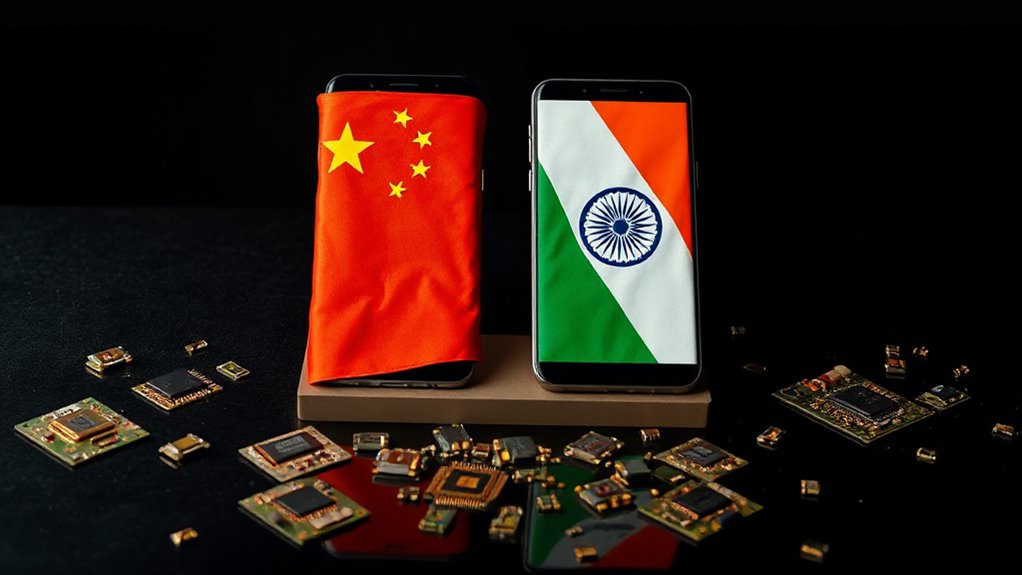
How India Captured 44% of US Smartphone Imports in One Year?
India’s smartphone export story reads like a classic underdog tale. Just one year ago, India supplied only 13% of U.S. smartphone imports. By mid-2025, that number jumped to 44%. Think of it like a student going from a C to an A+ in one semester.
How? Apple leaned hard into its “China Plus One” strategy, building serious manufacturing muscle in India. Almost all of India’s export capacity pointed straight toward American consumers. The result was stunning — a 240% year-over-year growth surge by Q2 2025. India didn’t just grow. It completely changed the game. Meanwhile, Apple’s China-assembled share dropped sharply from 61% to just 25% in the same period, underscoring how decisively the supply chain shifted.
This rise didn’t happen in isolation — the United States replaced over $80 billion worth of goods it once sourced from China, actively rewiring its entire import network across multiple product categories. The shift also highlights growing risk management strategies companies use to diversify supply chains.
How India Dethroned China as America’s Top Smartphone Supplier?
Within just one year, India pulled off one of the biggest upsets in global trade. China once dominated America’s smartphone supply with a 61% share. Then came the tariffs. The United States slapped a massive 145% tax on Chinese imports. India faced only 26%. That gap made Indian-made phones markedly cheaper to ship to American stores. Major manufacturers also shifted production to take advantage of lower tariffs and alternative supply routes. Companies like Apple jumped at the opportunity. Samsung and Motorola followed. China’s share collapsed to just 25% while India climbed to 44%. Think of it like a relay race where the frontrunner suddenly tripped and a fast-rising competitor grabbed the baton. This shift reflects India’s growing role in global electronics manufacturing and its expanding presence in international supply chains.
The broader trade realignment extended well beyond smartphones, as the total value of US imports shifted away from China exceeded USD 80 billion across various product categories.
Where Vietnam and ASEAN Fit in This Supply-Chain Shift?
India did not grab America’s smartphone business alone. Vietnam quietly played a big role too. Samsung spent years building factories and supplier networks in Vietnam. That hard work made Vietnam the world’s third-largest phone manufacturer. Google even makes Pixel phones there. Vietnam and other ASEAN countries give brands a smart backup plan. Instead of depending only on China or India they can spread production across multiple countries. Think of it like not putting all your eggs in one basket. This flexibility helps companies avoid big problems if one country faces trade troubles or supply disruptions. India is now expected to surpass Vietnam in mobile phone exports by the end of 2025. Manufacturers also rely on supply-chain diversification to maintain resilience and access multiple sources of components and labor.
Why Apple and Other Brands Moved Smartphone Production to India?
Moving millions of iPhones out of China was not a small decision. Apple had good reasons though. Geopolitical tensions and COVID lockdowns at China’s “iPhone City” showed how risky depending on one country could be. European exchanges operate with similar features but with regional variations, including continuous trading during market hours.
India offered a younger and cheaper workforce which helped keep costs manageable. The Indian government sweetened the deal further by offering billions in financial incentives through its PLI scheme. Big suppliers like Foxconn and Tata jumped in quickly.
India also has a massive and growing population keen to buy smartphones. Manufacturing there meant Apple could build products and sell them in the same place. Apple is targeting 25% of iPhones to be produced in India by 2025, up from just 5–7% in 2022.
Samsung and Google are also ramping up manufacturing in India, further strengthening the country’s growing electronics sector.
What India’s Smartphone Surge Means for US-China Trade?
The rise of India’s smartphone industry is quietly shaking up one of the biggest trade rivalries in the world. For years, China dominated US smartphone imports like the only bakery in town. Now India supplies around 40% of US smartphone imports and even overtook China in specific quarters. As American companies diversify away from Chinese supply chains, India steps in confidently. This shift means the US relies less on a single country and trade between the world’s biggest economies looks noticeably different today. Overall smartphone exports from India surged 28% in 2025, reflecting the country’s rapidly expanding role as a global manufacturing hub driven by key assemblers like Foxconn Hon Hai and Tata Electronics. India’s export momentum is further underscored by the fact that mobile exports grew 40% in 2023–24, even as China and Vietnam experienced declines in their own export figures during the same period. The trend also highlights growing diversification benefits for companies seeking to reduce concentration risk in their supply chains.