


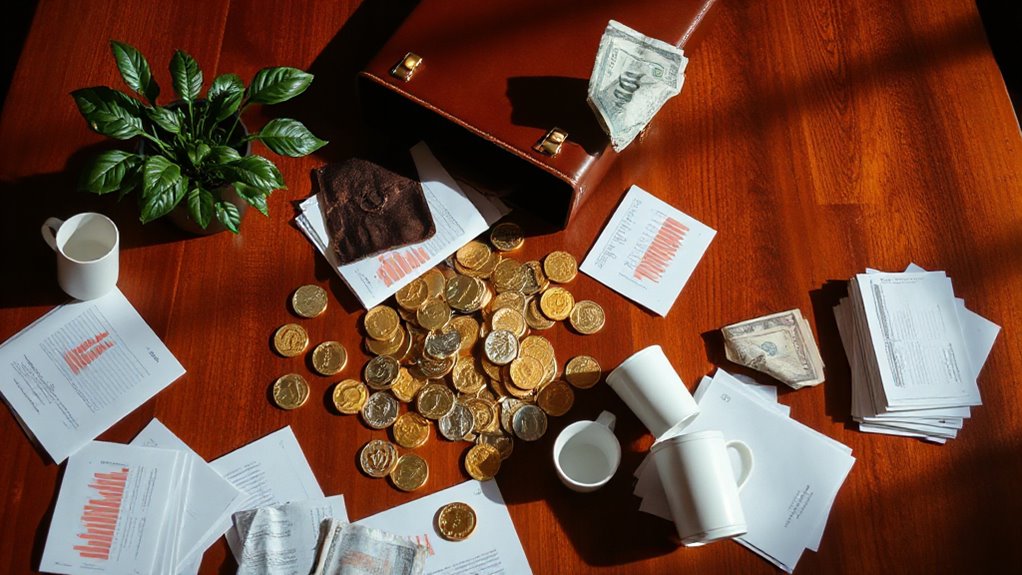
How did the economic system that once promised prosperity for all become a source of stress for so many families? The answer lies in several troubling trends that have quietly reshaped how our economy functions over the past fifty years.
The economic dream that once lifted all families has quietly transformed into a stress-inducing struggle for survival.
Since the 1970s, something strange happened to American workers. Companies became much more productive and profitable, but workers’ paychecks barely grew. Imagine if a bakery started making twice as many cookies but paid its bakers the same wages – that’s fundamentally what occurred across the entire economy.
Meanwhile, stable full-time jobs with good benefits became harder to find. Instead, many people found themselves juggling part-time gigs or temporary work that offered little security.
The job market took another hit in 2024 and 2025 when major tech companies and other sectors announced massive layoffs. Even college graduates struggled to find decent positions in their fields.
Government jobs, which once provided steady employment, also disappeared as budget cuts swept through public offices.
At the same time, American families went deeper into debt than ever before. By 2025, total household debt reached a staggering $18.5 trillion. That’s like every family owing the equivalent of a house even before buying one.
Two-thirds of households had less than $1,000 saved for emergencies – barely enough to cover a minor car repair. Rising rent costs made things worse, with many families spending over half their income just to keep a roof over their heads.
The government itself struggled with money problems too. Federal debt ballooned to around $36-38 trillion by 2025, making it harder for politicians to spend money on programs that might help struggling families.
Credit rating agencies even downgraded America’s financial reputation, like a report card showing declining grades.
Large corporations grew more powerful and concentrated, while smaller businesses found it harder to compete. This economic concentration created conditions where over 90% of new income flows to the wealthiest 1% of Americans. Consumer confidence has fallen five months straight, reaching its lowest point in 12 years as families feel the squeeze of these economic pressures. Some investors turned to alternative cryptocurrencies as a hedge against traditional financial instability, though these markets proved equally volatile. This created an economy that worked well for those at the top but left many ordinary families feeling like they were running uphill on a treadmill that kept getting faster.
Related Posts