










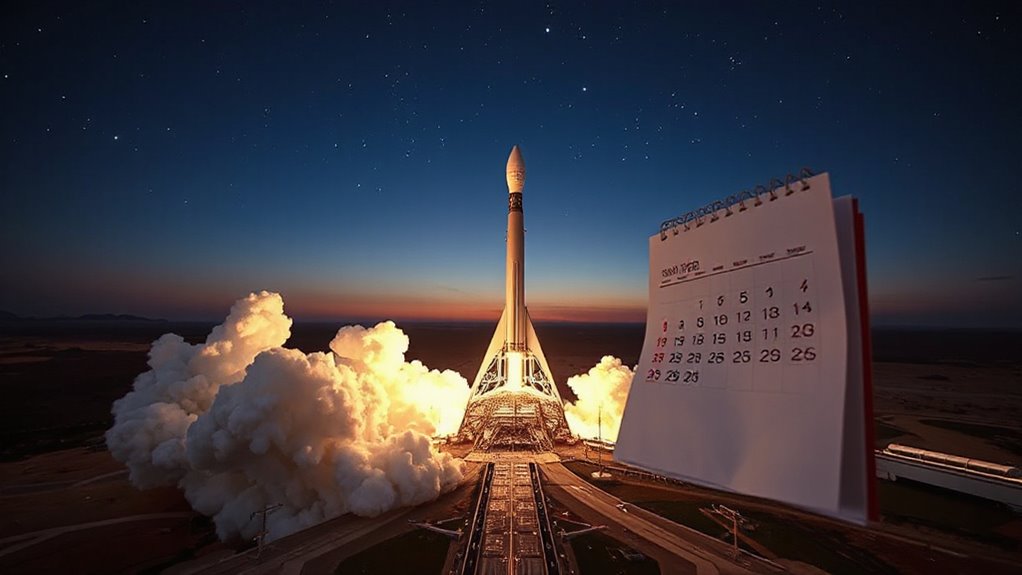
SpaceX’s Mars Timeline Has Officially Collapsed
SpaceX’s Mars dreams have hit some serious roadblocks. Elon Musk officially pushed back his Mars plans by five to seven years in February 2026. The original 2026 uncrewed mission got bumped to 2028. Crewed missions shifted from 2030 all the way to 2031–2033.
That is quite a slide for a program once promising Mars boots on the ground “soon.” Since 2016, Musk has announced nine public Mars deadlines. Every single one got missed.
The average delay runs about 3.2 years per promise. At this point, Mars timelines feel less like schedules and more like very optimistic suggestions. Mars transfer windows occur only about every 26 months, meaning each missed deadline costs years, not months. A 2024 Nature study concluded that a crewed Mars mission using Starship was unworkable due to fundamental engineering constraints. Monetary policy shifts can also affect funding and investor sentiment for large aerospace projects, particularly through changes in interest rates.
The Real Reasons SpaceX Keeps Delaying Mars
Missing a deadline once might be bad luck. Missing it three times in a row is a pattern.
SpaceX keeps delaying Mars for three real reasons.
First, Starship keeps exploding. Three consecutive test flights failed in 2025.
Second, the FAA keeps hitting the brakes. Every explosion triggers safety investigations that eat up months.
Third, orbital refueling still does not work. Without it, no Mars mission is possible.
Musk himself gave it just a 50% chance of being ready.
These are not small bumps. They are the kind of problems that push timelines back by years. Musk now acknowledges that Mars-Earth alignment cycles of more than two years make rapid iteration on Mars extremely difficult compared to the Moon. SpaceX has also not publicly detailed solutions for life-support and radiation protection, systems that must function reliably across a months-long journey through deep space.
Central banks’ decisions on interest rates can influence funding costs for long-term projects like Mars missions, affecting their budgets and timelines interest-rate policy.
The 26-Month Launch Window Problem Nobody Can Engineer Around
Even the best engineers on Earth cannot argue with gravity. Mars launch windows open only every 26 months and last just a few weeks. European markets operate on regular local hours and observe daylight saving changes, but that rhythm does not affect orbital mechanics. That schedule is set by orbital mechanics and nothing else.
No extra effort or better rockets can move it.
Earth travels faster than Mars around the Sun and the geometry has to line up just right.
Miss the window and the next one arrives roughly two years later.
It is like missing a train that only runs once every 26 months and the next one is not negotiable either.
When the geometry does align, spacecraft follow a Hohmann Transfer orbit, an elliptical path around the Sun that takes roughly 7 to 9 months to complete.
Each Mars-bound Starship requires roughly 1,200 tons of propellant, making every missed window a costly two-year setback for both mission timelines and the refueling infrastructure built to support them.
What Prediction Markets Say About Mars Mission Odds
When real money is on the line, people tend to get serious about what they actually believe.
Kalshi traders give SpaceX only a 31% chance of landing anything on Mars before 2030. Human missions? Even lower at 17%. OTC trading can concentrate risk in smaller, less transparent ventures.
That gap tells a real story.
That gap isn’t just a number. It’s the difference between hard and nearly impossible.
Sending robots somewhere hard is tough. Sending people is much harder.
Meanwhile Polymarket shows declining confidence in Starship launches dropping from 56% to 40% in just one week.
These aren’t casual opinions.
People are betting actual dollars.
And right now those dollars are quietly but clearly saying the same thing: humans on Mars this decade looks unlikely. Interestingly, traders think a humanoid robot has a 51% chance of walking on Mars before any human does.
If you bet yes on a robotic Mars landing before 2030, the market rewards you with a 3.2x return, reflecting just how uncertain even the uncrewed mission remains.
When Could Humans Realistically Land on Mars?
So prediction markets have drawn a pretty clear picture of doubt.
But when could humans realistically land on Mars? Most experts point to somewhere between 2035 and 2041.
NASA’s official roadmap targets 2039.
SpaceX’s Elon Musk suggests 2029, though that seems optimistic.
Think of it like planning a very long road trip — except the drive takes nine months each way.
Astronauts would also wait 500 days on Mars before heading home.
The whole trip runs nearly 1,000 days.
Launch windows to Mars only open every 26 months, dictated by the orbital alignment between Earth and Mars.
With only 30% of funding secured, the earlier dates look more like wishes than schedules.
The vehicle returning home would clock over a billion miles on its odometer by the time the mission is complete.
Mission planning also depends on public funding and international partnerships to cover costs and logistics.