









Why Bangladesh Bet on Nuclear Power
Why did a small, densely packed country decide to build one of the most complex machines on Earth?
Bangladesh needed power — badly.
Its population was growing fast and its economy was humming along, but the lights kept going out.
The country leaned heavily on natural gas, which was getting expensive and running low.
Imported fuels made things worse since global prices bounce around like a basketball.
Bangladesh needed something steady and reliable.
Nuclear power promised exactly that: firm electricity around the clock.
It was expensive upfront, like buying a car instead of renting one, but cheaper over decades.
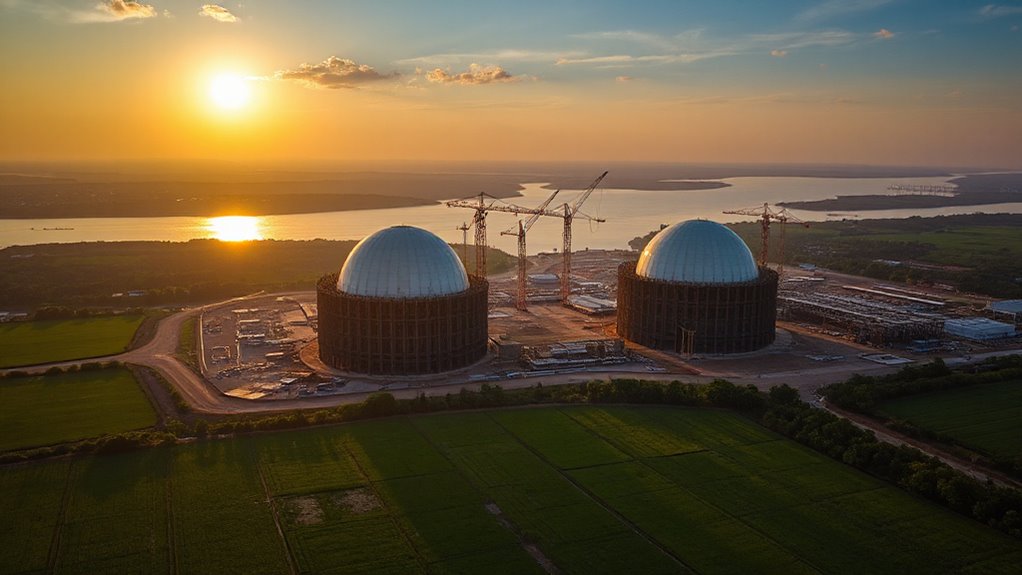
The Rooppur Nuclear Power Plant, located on the bank of the Padma River, is being built with two 1200 MW units.
Electricity demand has been rising at roughly 7% per year, putting enormous strain on a grid already struggling to keep up.
To manage long-term costs and stability, the government viewed nuclear as part of a strategy to reduce reliance on volatile imported fuels.
What the VVER-1200 Reactor Actually Brings to Bangladesh
When Bangladesh decided to go nuclear, it did not pick a small or simple machine. The VVER-1200 is a Generation III+ pressurized water reactor — basically the modern smartphone version of older reactor designs.
Each unit produces 1,200 megawatts of electricity. Together both units deliver 2,400 megawatts total.
Each unit generates 1,200 megawatts. Together, both reactors deliver a combined 2,400 megawatts of continuous electricity.
That covers roughly 9% of Bangladesh’s electricity needs. Unlike solar or wind power the reactor runs continuously providing steady baseload power.
It reduces dependence on fossil fuels and strengthens grid stability. The technology already operates successfully at Novovoronezh II in Russia giving Bangladesh a proven reliable machine from day one.
Researchers at MIST have used ANSYS software to analyze the thermo-mechanical behavior of the VVER-1200 fuel rod, examining how UO₂ fuel with zirconium alloy cladding performs under the thermal stress and pressure conditions of normal reactor operation.
Rooppur unit 1 recently completed hydraulic tests at 24.5 MPa pressure, marking a key step toward hot functional tests and eventual grid connection.
Futures markets also illustrate how energy projects can be hedged through standardized contracts to manage price risk over time.
What Rooppur’s 2,400 MW Means for Bangladesh’s Grid
Understanding what the VVER-1200 reactor actually does is one thing.
Seeing what 2,400 MW means for Bangladesh’s grid is another.
That capacity equals roughly 8.7% of the country’s total installed power.
Think of it like adding a giant battery that never runs out.
Bangladesh currently struggles with peak shortages above 2,000 MW some seasons.
Rooppur’s full output could cover most of that gap.
It also pushes clean firm capacity from under 3% to about 12%.
Both units must be online first though.
Unit one arrives around 2026–2027 and delivers steady baseload power around the clock. BDPolicyLab tracks this development across its seven sector deep-dives, including dedicated energy analysis.
Authorities are also reviewing whether the existing transmission system can absorb the added load, with grid frequency stability identified as a key technical concern before commercial operations begin.
Adding large-scale generation will significantly affect the country’s installed capacity mix and planning for future demand.
How Russia’s Loan Made Rooppur Possible
Building a nuclear plant costs an enormous amount of money — and for Bangladesh, that was the biggest hurdle of all.
Russia stepped in with a loan covering about 90% of the total $12.65 billion cost. That made it the largest foreign loan Bangladesh had ever taken.
Russia also provided an earlier $500 million loan for planning and training.
The main loan carried low interest rates and generous repayment terms stretched across decades. Without Russia implying “we’ll front almost all of it,” Rooppur likely would have stayed a dream on paper for many more years.
The inter-governmental loan agreement was signed in Moscow on 26 July 2016, marking the moment both legal and financial foundations were formally established for the project.
Beyond financing, Russia’s involvement extends through the plant’s entire 60-year operational lifespan, covering fuel delivery, maintenance, and technical assistance. This level of long-term support reflects how private competition in energy markets can be complemented by government-backed partnerships.
Why Rooppur Is the Model Emerging Economies Are Watching
Why does a power plant in a small South Asian country matter to the rest of the world?
Because dozens of other countries are watching and taking notes.
Many developing nations share Bangladesh’s problem: they depend heavily on imported fuels and need steady electricity to grow.
Rooppur shows whether nuclear power can actually work in that situation.
It is like a real-world experiment that nobody wants to fail.
If Bangladesh pulls this off successfully, it gives other emerging economies a clear example to follow.
Success here could make nuclear energy a serious option for countries still searching for reliable power.
Proper validation requires thorough testing across varied conditions, including long-term data to assess reliability and resilience over time.