










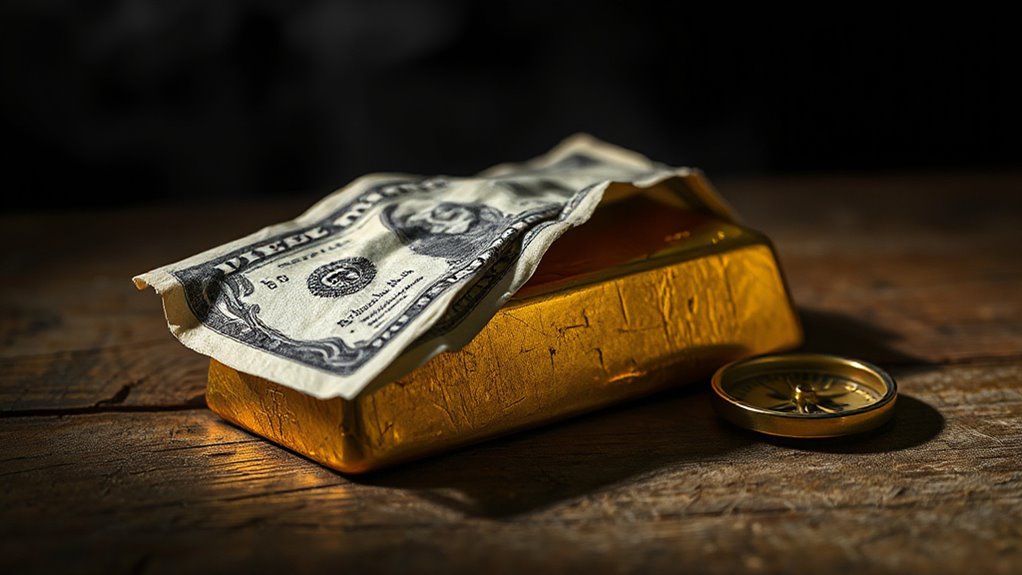
What Was the Bretton Woods Agreement?
In July 1944, representatives from forty-four allied nations gathered at the Mount Washington Hotel in Bretton Woods, New Hampshire, for one of the most important economic meetings in history.
Seven hundred thirty delegates came together with a clear mission: build a stable global economy after World War II.
Think of it like agreeing on the rules of a board game so nobody flips the table.
Leaders wanted to stop countries from deliberately weakening their currencies to gain unfair trade advantages.
The result was the Bretton Woods Agreement, a framework that reshaped how nations managed money and traded with each other. The agreement established two major institutions, the IMF and World Bank, to help maintain economic stability and support reconstruction efforts.
The system placed the US dollar at its center, with currencies defined in dollars and only the dollar convertible to gold at a fixed rate of thirty-five dollars per ounce.
Steve Jobs’ modest, working-class family background and hands-on upbringing illustrate how individuals from humble origins can rise to reshape global industries.
The Bretton Woods Dollar-Gold System That Rewired Global Finance
Once the Bretton Woods Agreement was in place, its architects needed a concrete system to make it actually work.
A grand agreement on paper meant nothing without a working system to bring it to life.
Their solution was straightforward: anchor the dollar to gold at $35 per ounce and peg every other currency to the dollar.
Think of it like a solar system where the dollar was the sun.
Foreign governments could exchange dollars for actual gold anytime.
This kept everyone honest.
Other countries maintained fixed exchange rates through careful market intervention.
Capital controls limited risky money flows.
Together these rules reduced exchange-rate chaos and helped global trade expand steadily throughout the postwar decades.
The IMF monitored exchange rates and lent reserve currencies to countries struggling with balance of payments deficits.
The Federal Reserve Bank of New York committed to buy or sell gold at that fixed price without limits, giving the entire system its credibility.
Central banks also acted as an international backstop by coordinating policy and providing liquidity during crises, reflecting their role in financial stability.
The Institutions Bretton Woods Created: IMF and World Bank
Building that dollar-gold framework was only part of the Bretton Woods story. The 1944 conference also created two powerful institutions still operating today.
First came the International Monetary Fund. Think of it as a financial emergency room for countries struggling with money shortages. The IMF also helps manage exchange rate stability and provides policy advice to member countries.
Second came the International Bank for Reconstruction and Development, later called the World Bank. It acted more like a long-term doctor helping poorer nations grow stronger economies.
Both institutions officially launched December 27, 1945 after 21 countries signed on.
Together they became known as the “Bretton Woods twins,” designed to keep the global economy stable and moving forward. The conference itself brought together 730 delegates representing forty-four nations to hammer out the terms of this new global financial order. Today, the IMF counts 190 member countries among its membership, a testament to how far the organization has grown since those foundational days in New Hampshire.
Why Was Bretton Woods So Controversial?
Not everyone walked away from Bretton Woods feeling like a winner. Many nations had serious concerns about the deal. Here are three big reasons why:
Not every nation left Bretton Woods satisfied — many carried serious concerns about the fairness of the deal.
- Dollar favoritism – The system made the U.S. dollar the world’s top currency giving America enormous financial power.
- Unequal voice – Smaller countries had little say while the U.S. and U.K. made most decisions.
- Lost freedom – Countries had to follow fixed exchange rules limiting their economic choices.
Critics felt the rules protected American interests more than global fairness. The controversy never fully disappeared. Today, many world leaders and economists continue to call for a “new Bretton Woods” moment to restructure global economic governance. The system ultimately collapsed in August 1971, largely due to a coordination failure of national policies that no effective multilateral mechanism could prevent. Central banks’ control over policy interest rates and their impact on global capital flows was a key factor shaping countries’ responses under the system.
How the Bretton Woods Collapse of 1971 Shaped the Dollar’s Lasting Power
In the summer of 1971, the United States made a decision that shook the entire world.
President Nixon announced that dollars could no longer be traded for gold. Basically, America changed the rules mid-game.
This became known as the “Nixon Shock.”
Many expected the dollar to weaken without gold backing it. Instead, the opposite happened.
The dollar became even more powerful.
Other countries still needed dollars for international trade and kept them as reserve currency.
So even after losing its golden anchor, the dollar somehow tightened its grip on the global economy.
Surprising, right?
Before Nixon’s announcement, foreign gold claims had already surpassed what the United States actually held in reserve by 1967.
The Dow Jones Industrial Average surged by 33 points on August 16, marking the largest single-day gain recorded at that point in history.
Central bank rate cuts later influenced global capital flows and helped maintain demand for dollars.